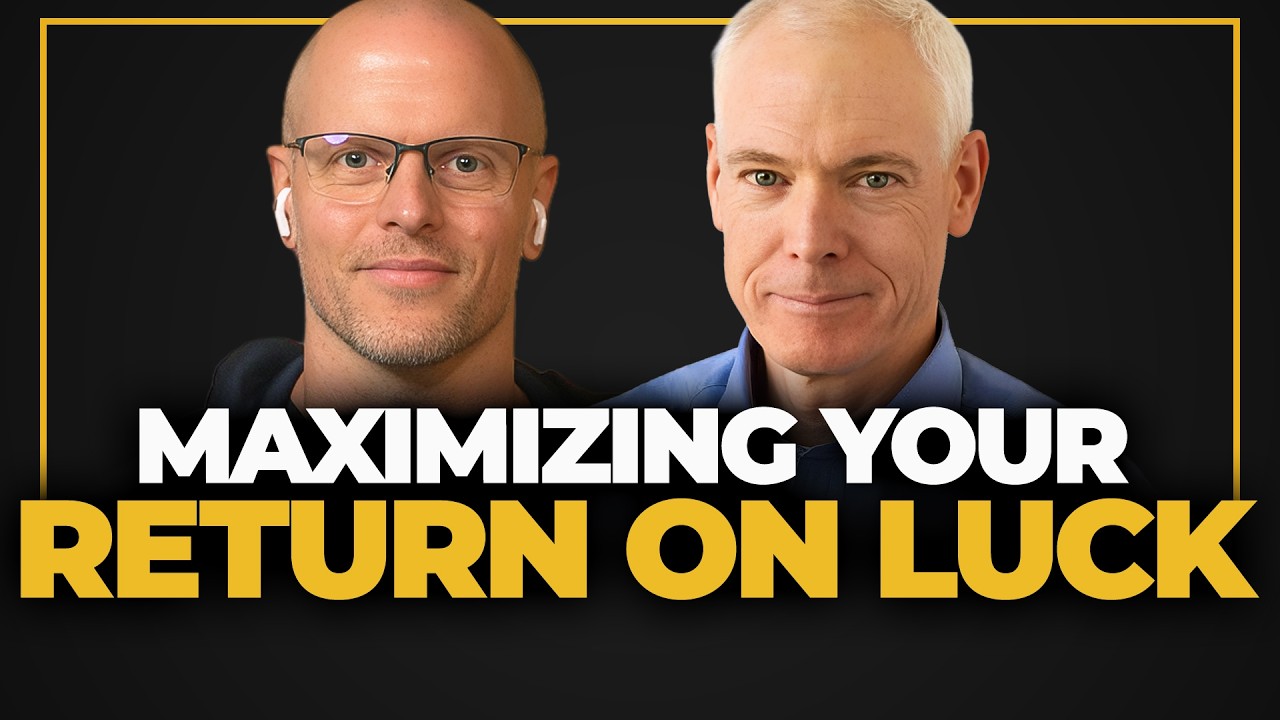
Jim Collins — Researcher and author of Good to Great, Built to Last, and Great by Choice; here discussing his new book What to Make of a Life: Cliffs, Fog, Fire, and the Self-Knowledge Imperative, the product of 12+ years of research.
The gist
Jim Collins describes how his new book grew out of a question about self-renewal, seeded by mentor John W. Gardner and by his wife Joanne's wrenching end to a world-champion athletic career. Studying matched pairs of people through 'cliff events' that upend a life, he developed the central ideas of encodings, fog, and getting a return on luck. He and Ferriss dig into how to discover and trust your encodings, how to lead a small team by putting people in seats where they're 'in frame,' and how a disciplined 'punch card' protects time for one's core work. The conversation repeatedly argues that great work comes late in life when people are in frame, not just in youth, and that flipping the arrow of money keeps people from burning out. Collins closes by reaffirming that his truest measure of success is whether his wife Joanne likes and respects him more as the years go by.
Big reveals
- Collins says he has more energy at 67 (68 now) than at 37, needs less sleep, and looks forward to 4 a.m. so he can leap into the day with childlike anticipation.
- The book's origin: Joanne gasped 'I feel like I'm dying' when her hamstring injury ended her world-champion athletic career, fusing with the John Gardner self-renewal seed to inspire the study of 'cliff events.'
- The research method on self-renewal kept leading Collins to a far bigger question, which became the book's title and core: 'What to make of a life.'
- Collins defines 'encodings' as durable inner capacities awaiting discovery, distinct from strengths, and allocates 70 of 100 points to trusting encodings over discovering them.
- To protect his work, Collins runs a 'punch card' system based on Warren Buffett's view that any commitment is a non-refundable punch, calculating points weekly and capping yeses tightly.
- Collins lays out three kinds of luck (what luck, who luck, and zeit luck) and the concept of 'return on luck'—the big winners didn't get more luck, they made more of it.
- Mentor Irv Grousbeck's lesson that an 'option to come back' has negative value on a creative path because, in low-odds games, anything short of 100% commitment is effectively a zero.
- The 'flip the arrow of money' idea: people who never burn out treat money as fuel for the work they're encoded for, rather than doing the work to make money.
Things worth remembering
- Collins gave up rock climbing and now does intense cycling with Joanne, riding huge mountain passes in the Italian Dolomites with heart rate above 160 for hours.
- Collins gets 'two mornings a day' by napping anywhere on demand—he once fell asleep on a backstage couch five minutes before speaking to 3,000 people.
- He travels with his own coffee setup: Peet's ground Arabian Mocha Java, a cone filter, filters, and a water boiler, to replicate his morning 'boot up sequence' anywhere.
- Joanne Collins was a world-champion Ironman athlete and one of the first women in Nike's original Just Do It campaign, winning the 1985 Hawaii world championship by about 90 seconds despite a chronic hamstring injury.
- Asked for one word to describe living with Jim, Joanne answered, after a long pause, 'exhausting.'
- Test pilot John Glenn's encodings only clicked when he first flew; under extreme danger his heart rate would actually drop, and Royal Crown Cola took up ~10% of his life but 0.2% of his memoir.
- Collins and Morten Hansen defined a luck event by three tests: you didn't cause it, it has potentially significant consequence, and it came as a surprise.
- On the day Built to Last published, Collins found he and Jerry Porras owned the front of USA Today's money section; he assumed it was an elaborate hoax until learning they were 50,000 copies back-ordered overnight.
- To find a matched pair for Benjamin Franklin, Collins's team screened everyone who signed the Declaration and attended the Constitutional Convention, discovering Roger Sherman, who 'saved the Constitution twice.'
- Toni Morrison didn't become a writer until her 40s, published Beloved at 56 and Jazz at 61; Barbara McClintock's transposition breakthrough came after her late 40s—evidence great work comes late.
Recommended in this episode
Books, products and media the guest or host genuinely endorsed here — with the buy link.
Affiliate link — we may earn a commission at no extra cost to you.
What to Make of a Life
Jim Collins
“the latest work What to make of a life and we will certainly get to that” — Tim Ferriss 00:01:32Find it on Amazon
Good to Great
Jim Collins
“I was off working on Built to Last and Good to Great. I was working on my company research” — Jim Collins 00:16:35Find it on Amazon
Built to Last
Jim Collins
“I was off working on Built to Last and Good to Great. I was working on my company research” — Jim Collins 00:16:35Find it on Amazon
Self-Renewal
John W. Gardner
“He had written a great book, a little book, back a number of years ago on self-renewal” — Jim Collins 00:16:03Find it on Amazon
Great by Choice
Jim Collins
“goes all the way back to when Morten Hansen and I were doing our book Great by Choice” — Jim Collins 01:37:09Find it on Amazon
How the Mighty Fall
Jim Collins
“Good to Great, Built to Last, Great by Choice, How the Mighty Fall, so forth, where I was doing match pair studies” — Jim Collins 01:56:57Find it on Amazon