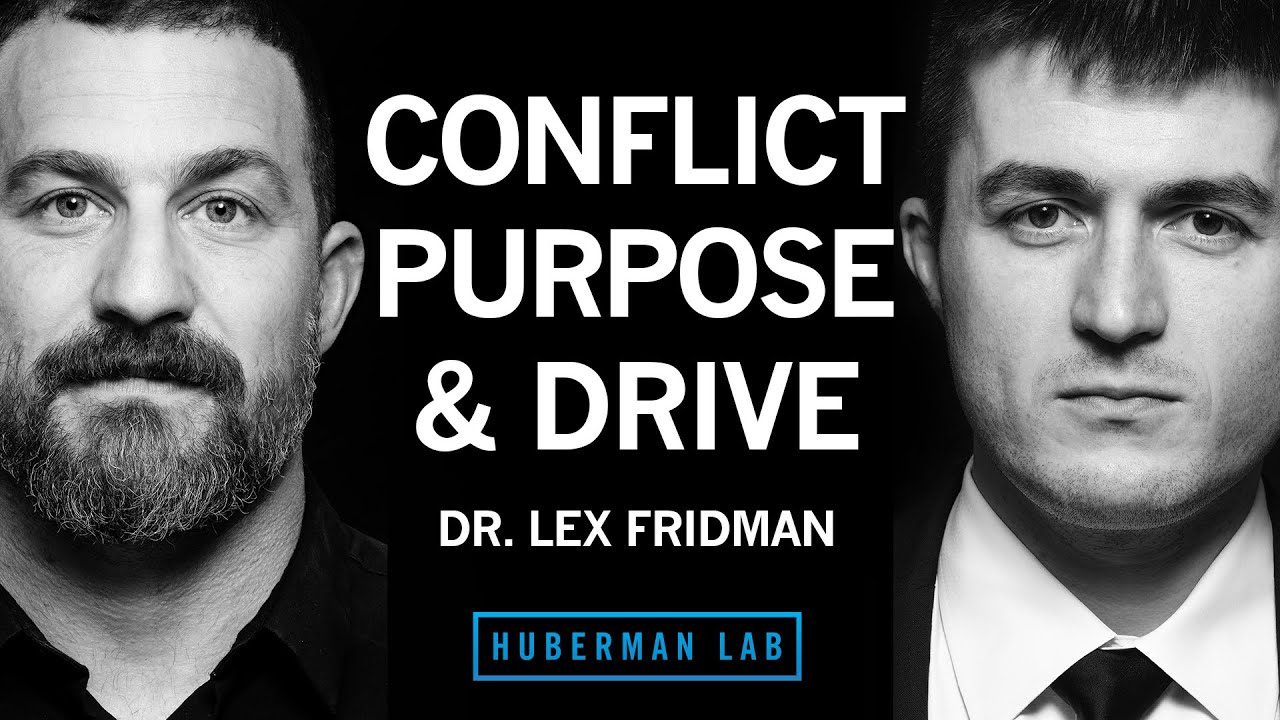
Lex Fridman — AI, robotics and electrical engineering researcher who teaches at MIT and hosts the Lex Fridman Podcast. He inspired Andrew Huberman to start his own podcast.
The gist
Recorded for episode 100 of the Huberman Lab Podcast, Lex Fridman returns just days after a trip to wartime Ukraine, where he interviewed hundreds of people in Russian. He describes how war creates generational hate, how humans adapt to violence, and how losing everything makes people value relationships above possessions. The conversation moves through social media psychology, the failures of scientific peer review, controversial podcast guests like Donald Trump and Andrew Tate, and Lex's distrust of big pharma after interviewing the Pfizer CEO. It closes on Lex's deeply personal struggle: the calling to leave his comfortable life and launch a social-robotics AI startup, the neuroscience of motivation, and a recitation of a Robert Frost poem.
Big reveals
- There would be no Huberman Lab Podcast were it not for Lex, who urged Andrew to start one.
- War's most painful lesson: it creates generational hate, so people end up hating an entire people, not just leaders or soldiers.
- When Russia gave guns to everybody and released prisoners early in the war, crime went to zero.
- Lex argues a company can do evil even when every individual inside it, including the CEO, is a good person.
- Lex says he gave away his MIT salary hoping a near-zero bank account would force him to launch a startup.
- Lex confirms the robotics startup is a calling, not a compulsion, and he hopes it never goes away.
- Lex reads Robert Frost's 'Stopping by Woods on a Snowy Evening,' interpreting it as a man choosing to live.
- Lex still gets heavy hate for interviewing the Pfizer CEO and says he doesn't know the right answer.
Things worth remembering
- Lex talked to several hundred people in Ukraine, most in Russian, generating 30-40 hours of footage he struggled to edit himself.
- In the Kherson region he stayed in hotels where all lights stayed off; food was once a day, cheap, mostly meat and borsch.
- Zelensky had only about 30% approval before the war but became a beacon by refusing to flee Kyiv.
- The Watson-Crick double-helix paper was never peer reviewed at Nature; it was an editorial decision.
- A 15% failure rate (about 85% success) is described as optimal for neuroplasticity and learning.
- Poker great Phil Ivey exploited slightly asymmetric card-back printing by asking the dealer to rotate cards.
- A Neuralink neurosurgeon implanted a radio receiver under his and his wife's skin to open house locks.
- Lex says his hardest jujitsu belt was the brown belt, not the black, due to grueling competition against young athletes.
- Lex wears a black suit and tie to take every moment seriously, inspired by Richard Feynman and the Mad Men era.
- Lex's advice to people in their 20s: find one thing and work harder at it than anything else, even if it destroys you.