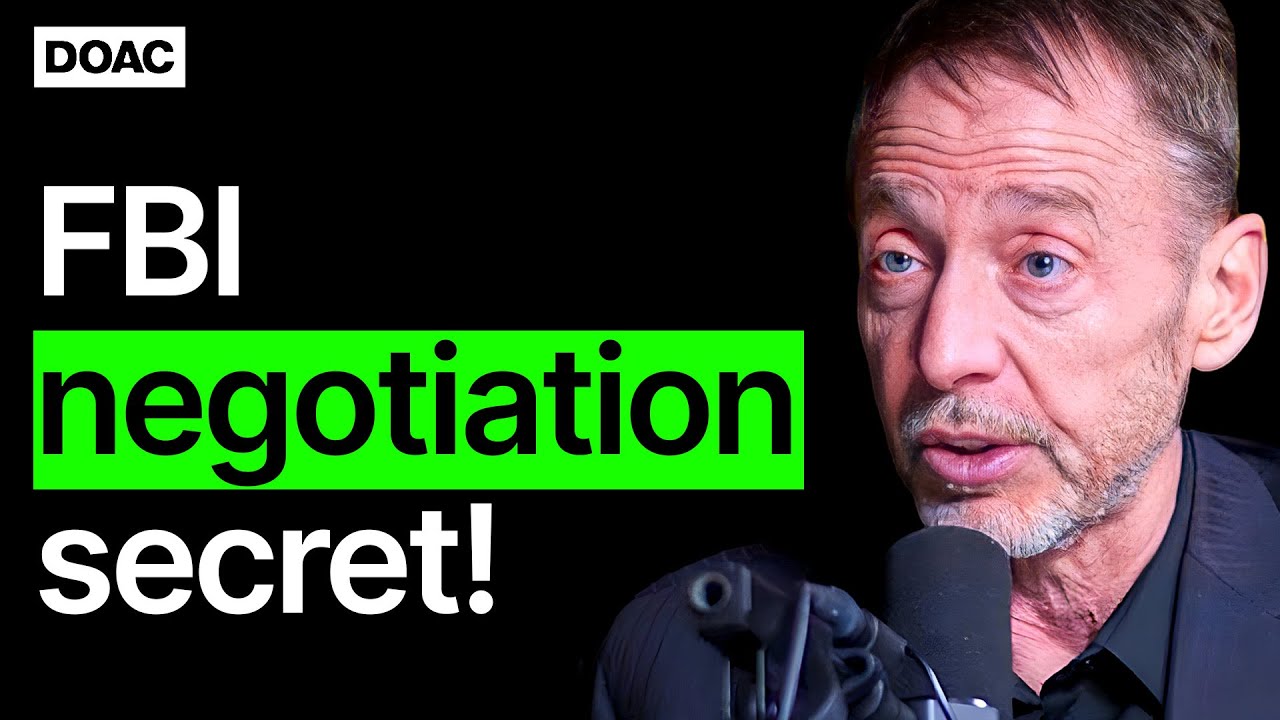
Chris Voss — Former FBI lead international kidnapping and hostage negotiator, founder of the Black Swan Group, and bestselling co-author of Never Split the Difference.
The gist
Chris Voss traces his path from an entrepreneurial blue-collar upbringing through the FBI SWAT and hostage rescue tryouts to becoming a hostage negotiator, sparked by a knee injury and a suicide-hotline apprenticeship. He explains the core mechanics of his method: tactical empathy, labeling emotions, mirroring, the three negotiator voices, and pulling 'that's right' from a counterpart. He and host Stephen Bartlett run a live role-play of a bank robber demanding a car, illustrating how questions force pondering and ownership. Voss connects these skills to business and romantic relationships, stressing listening, collaboration, and reputation over deception. He also reflects on the trauma of cases where hostages died and the idea of post-traumatic growth.
Big reveals
- Voss got into FBI negotiation only after the team head told him to go volunteer on a suicide hotline first — he was one of just two of over a thousand people she told who actually did it.
- His first real negotiation was a Chase Manhattan bank robbery with hostages, the first such case in New York City in over 20 years.
- A simple mirror ('you only have one van') caused a control-freak bank robber to blurt out details that convicted a third, previously unknown getaway driver.
- He refuses to lie even in extreme scenarios, arguing a liar will out-lie you and your reputation is permanently at risk.
- In the Burnham/Abu Sayyaf case in the Philippines, two of three remaining hostages were killed by friendly fire in a botched rescue.
- Voss realized he was carrying too much grief and reframed it as post-traumatic growth, making strategy changes that later saved lives.
- Never Split the Difference has sold more than two million (nearly 2.5 million) copies worldwide.
Things worth remembering
- Loss looms larger than gain — Kahneman's prospect theory; researchers estimate people feel loss two to nine times more than an equivalent gain.
- The 'drama triangle' — victim, protector, persecutor — describes difficult people on hotlines and in business alike.
- Hostage negotiators succeed about 93 percent of the time, meaning seven percent of cases still end badly.
- Humans split roughly evenly into three negotiation types tied to the caveman fight/flight/befriend response.
- A calm, soothing 'analyst' voice triggers an involuntary neurochemical calming response you cannot fully stop.
- fMRI studies show that simply labeling a negative emotion reduces electrical activity in that part of the brain every time.
- Saying 'that's right' signals genuine understanding and, per Voss, releases oxytocin that makes people more likely to tell the truth.
- 'I'll try' is a classic soft refusal — Voss instead says he doesn't think it'll happen but will advocate, shifting from adversarial to collaborative.
Recommended in this episode
Books, products and media the guest or host genuinely endorsed here — with the buy link.
Affiliate link — we may earn a commission at no extra cost to you.
Never Split the Difference
Chris Voss
“when I was reading through the principles in your book never split the difference so much of it I could relate to” — Stephen Bartlett 00:46:40Find it on Amazon