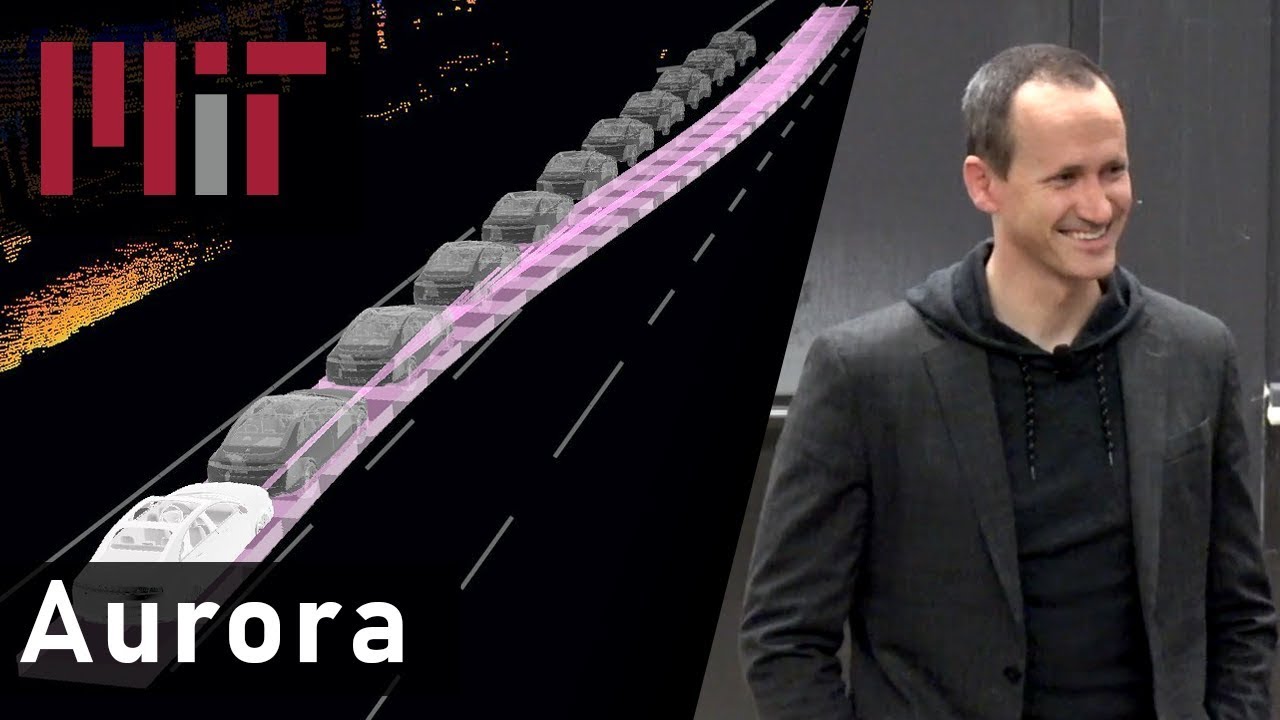
Sterling Anderson — Co-founder of self-driving startup Aurora; former head of Tesla's Autopilot team; MIT PhD on shared human-machine control of vehicles.
The gist
In this MIT talk hosted by Lex Fridman, Sterling Anderson traces his decade in self-driving, beginning with PhD work on an 'intelligent co-pilot' that constrains a vehicle within a safe state-space tube rather than following fixed paths. He recounts experiments showing the co-pilot reduced collisions and made drivers feel more in control even while it quietly took significant authority. He describes leading Tesla's Model X and Autopilot programs before co-founding Aurora in December 2016 with Chris Urmson and Drew Bagnell. He explains Aurora's non-threatening, partner-driven business model and its newly announced deals with Volkswagen and Hyundai, then takes audience questions on lidar, ethics, security, jobs, and vehicle-to-vehicle communication.
Big reveals
- Anderson founded Aurora in December 2016 with Chris Urmson (ex-Google self-driving lead) and Drew Bagnell (ex-Uber autonomy/perception lead).
- Before Aurora, he and his MIT advisor started two earlier companies, first 'gimlet' then 'ride,' aiming to license shared-control tech to automakers.
- Aurora operates fleets in Palo Alto and Pittsburgh and announced partnerships with Volkswagen Group and Hyundai Motor Company.
- He declines to disclose Tesla-specific non-public information when asked about Tesla's avoidance of lidar.
- He claims the self-driving fleet business case already closes economically even with today's high sensor costs.
- He explicitly worries about job displacement as a near-term negative of self-driving and urges planning a transition for transportation workers now.
Things worth remembering
- The intelligent co-pilot used homotopy classes derived from Voronoi diagrams and Delaunay triangulation to define families of safe paths.
- In remote-driving tests with about 20 subjects, engaging the co-pilot cut collision incidence by roughly 72%.
- Drivers reported feeling 12% more in control with the co-pilot active, even though it was taking about 43% of control authority.
- The co-pilot never exceeded half the available steering control, blending human and automated inputs.
- On average three parking spaces are allocated per vehicle in the US, and cars are used less than 5% of the time.
- An estimated 6 to 15 million people in the US lack access to transportation they need due to age, disability, or other factors.
- He argues there is no fundamental ('unobtainium') reason lidar must cost $70,000 once volumes rise and Tier 1 suppliers drive costs down.
- He recommends deploying self-driving first at the top end of the market, then costing the system down over time.