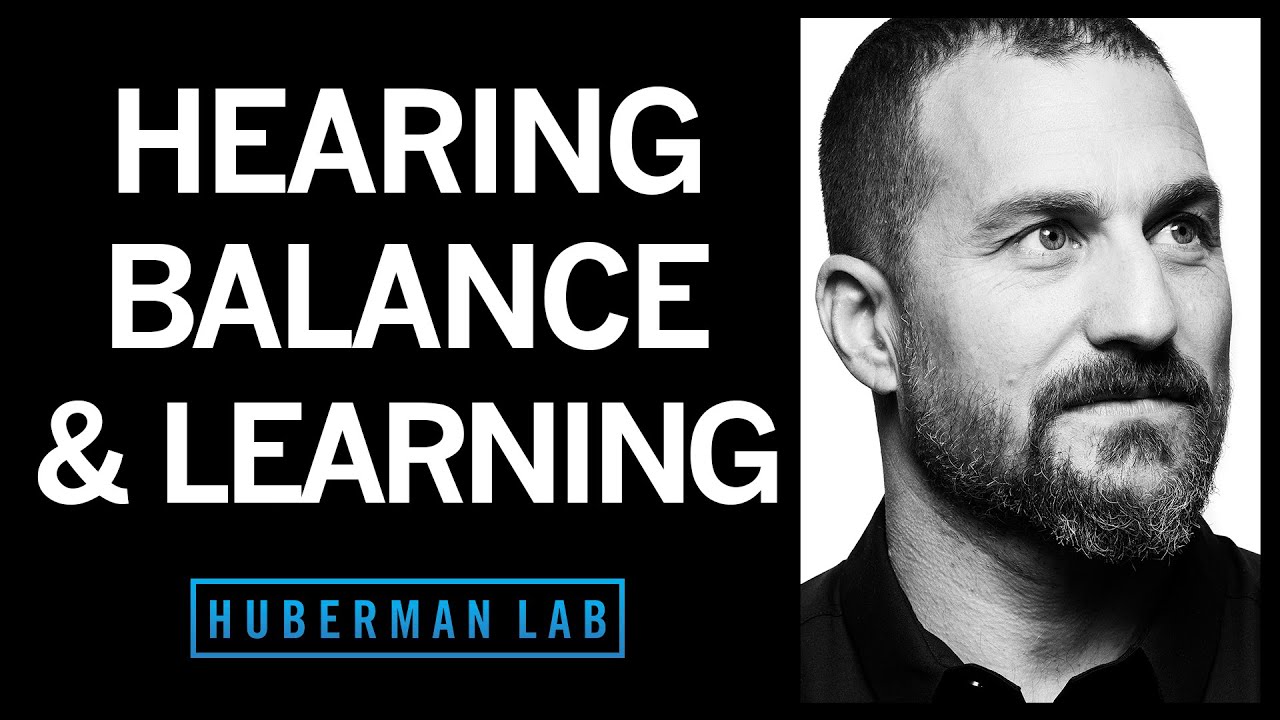
Andrew Huberman — Professor of neurobiology and ophthalmology at Stanford School of Medicine and host of the Huberman Lab Podcast, where he translates neuroscience into practical, science-based tools.
The gist
In this solo episode, Andrew Huberman breaks down the mechanics of the auditory system (pinna, eardrum, cochlea, hair cells, tonotopic maps) and the vestibular balance system (semicircular canals). He explains protocols to accelerate learning, including injecting 10-second rest periods during practice, using low-level white noise to raise baseline dopamine, and deliberately attending to the onset and offset of words. He covers tinnitus and four supplement compounds with peer-reviewed support, the oddity of otoacoustic emissions, and how ear size tracks biological age. He closes with balance training that couples vision with movement and the mood-boosting effect of forward acceleration while tilted relative to gravity.
Big reveals
- Injecting 10-second rest periods during practice produced much faster learning because the brain replays the skill about 20 times during each pause.
- Roughly 70% of people's ears emit sounds (otoacoustic emissions) they cannot perceive, sometimes detectable by others or microphones.
- Otoacoustic emissions differ by sex and self-reported sexual orientation, an unexpected dimorphism discovered by Dennis McFadden's lab.
- White noise improves learning by raising baseline dopamine release from the substantia nigra/VTA midbrain region.
- White noise during early development can blur the brain's tonotopic maps, so Huberman suggests considering avoiding all-night white noise for infants.
- Biological age can be estimated from average ear circumference using a specific formula, because ears keep growing via collagen synthesis.
- Forward acceleration while tilted relative to gravity (surfing, biking, snowboarding) best builds balance and triggers mood-boosting serotonin and dopamine.
- The classic advice to fixate on a point on the horizon to fight seasickness is wrong; you should let vision track freely with your vestibular system.
Things worth remembering
- The spacing effect was first proposed by Ebbinghaus in 1885 and has since been shown across many learning domains.
- We locate sound direction via interaural time differences, calculating which ear a sound reaches first.
- Elevation (up/down) of sounds is decoded by how the ear's shape modifies sound frequencies.
- About 60% of people can move their ears consciously, usually no more than two or three millimeters.
- People who can easily raise one eyebrow can almost always wiggle their ears, since both use the same motor pathway.
- Headphones make sound seem to come from inside your head rather than the surrounding room.
- Bats navigate by emitting clicks and reading the Doppler shift of the returning echoes.
- Four compounds have non-commercially-biased peer-reviewed support for modestly reducing tinnitus: melatonin, ginkgo biloba, zinc, and magnesium.
- Balancing on one leg becomes far harder with eyes closed because vision feeds directly into the vestibular system.
- Many people who think they have low blood sugar are actually lightheaded from low sodium and electrolytes.