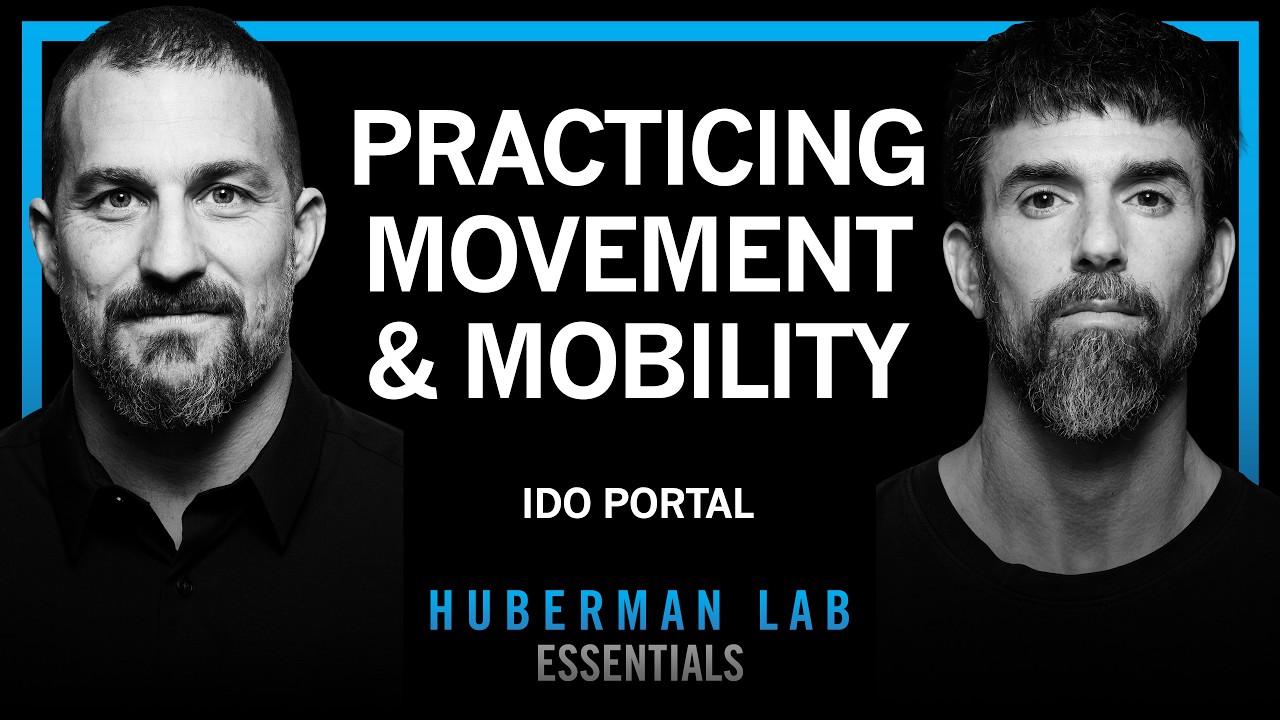
Ido Portal — Israeli movement teacher and practitioner known for pioneering the modern 'movement culture' philosophy, blending strength, play, and somatic awareness. He has coached athletes, performers, and even fighters in non-conventional movement training.
The gist
In this Huberman Lab Essentials episode, Andrew Huberman talks with movement teacher Ido Portal about how to think about and approach a movement practice. Ido frames movement as an open, decentralized system rooted in awareness of the body, mind, emotions, and environment rather than a fixed routine. They explore how vision, hearing, posture, body proportions, and even touch and proximity shape how we move, and why our culture over-emphasizes narrow focus over open panoramic awareness. A recurring theme is the value of playful experimentation and embracing variability to reach 'virtuosity,' versus rigidly chasing technical execution. Huberman adds neuroscience context on the magnocellular visual pathway, sound localization, and how eye position shifts alertness.
Big reveals
- Huberman admits that in anticipation of Ido's visit he caught himself injecting playfulness into going up and down stairs for the first time in decades.
- They describe a top tier above mastery called 'virtuosity,' where a practitioner invites variability and chance back in to do truly new things.
- Ido argues we do not move our eyes nearly as well as we think, and that eye movement can be trained with far-reaching effects.
- Huberman says he loathes the word 'biohack,' arguing tools grounded in innate physiology beat designed 'hacks.'
- Ido claims a book called 'Yoga Body' would 'destroy' many people's yoga practice by exposing yoga's modern, partly Western origins.
- Ido contends modern yoga is actually very linear, unlike traditional dances and martial arts which are round and curly like nature.
- Ido contrasts easy gratitude (watching a movie) with hard self-generated gratitude, suggesting many reported practice outcomes come from the easier path.
Things worth remembering
- Moshe Feldenkrais framed the body as three core elements: the nervous system, the mechanical muscle-skeleton system, and the environment.
- Ido teaches boxers to bob from the head rather than the feet, because moving the head automatically organizes the feet underneath you.
- Two clusters of neurons in cranial nerve nuclei link eye position to state: eyes up increase alertness, eyes down promote calmness.
- The magnocellular visual pathway has thicker, faster nerve fibers, and reaction time in panoramic awareness can be about four times faster than in narrow focus.
- Sound localization comes from a brainstem calculation of interaural time differences between when sound reaches each ear.
- Ido practiced movement by walking the crowded streets of Hong Kong for two hours, trying to avoid touching anyone.
- Modern yoga was shaped by influences like Swedish gymnastics and Mongolian contortionists, while ancient practice was barely posture-related.
- Ido cites Steve Paxton's contact improvisation as a way to explore touch, distance, and non-competitive movement with others.
Recommended in this episode
Books, products and media the guest or host genuinely endorsed here — with the buy link.
Affiliate link — we may earn a commission at no extra cost to you.
Yoga Body: The Origins of Modern Posture Practice
Mark Singleton (inferred)
“yoga there is a good book called the yoga body and which will destroy a lot of people's yoga practice and it goes into how did we get to this yoga” — Ido Portal 00:31:37Find it on Amazon