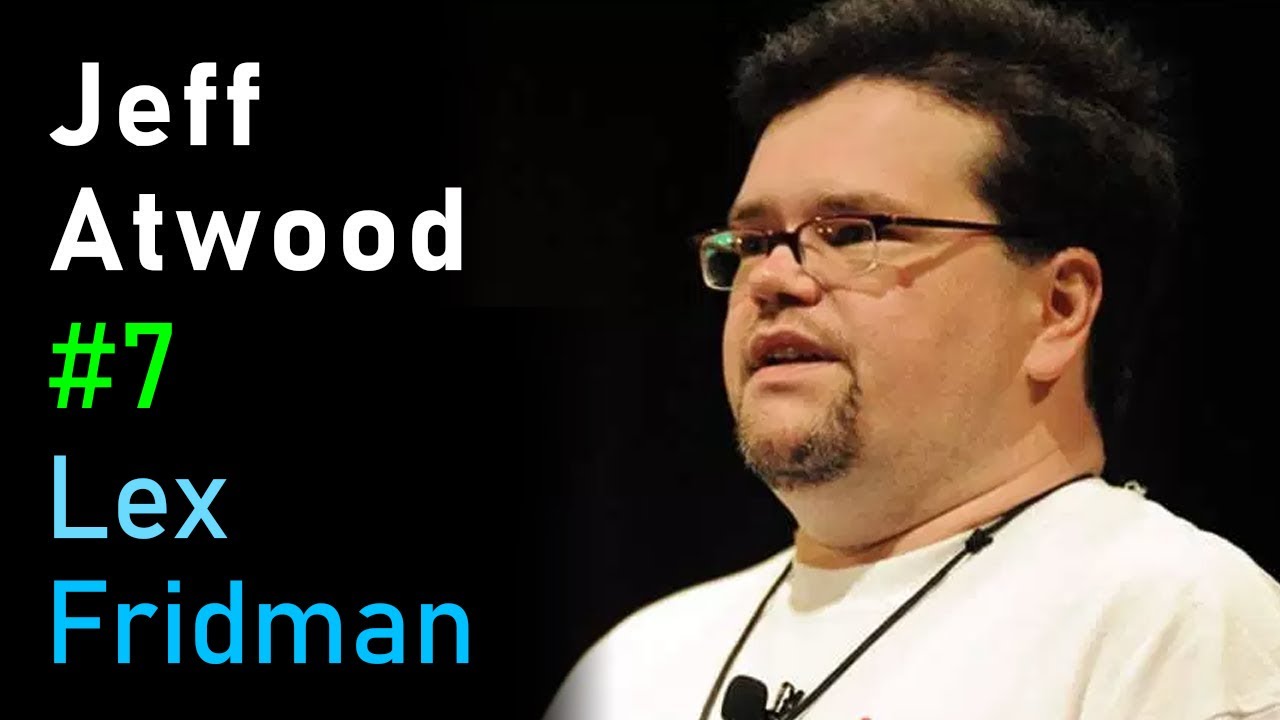
Jeff Atwood — Co-founder of Stack Overflow and Stack Exchange, author of the Coding Horror blog, and founder of the open-source community platform Discourse.
The gist
Jeff Atwood discusses what motivates programmers, arguing peer recognition and puzzle-solving drive the work more than money. He traces the origins of Stack Overflow as a focused Q&A wiki built by Frankensteining ideas from Digg, Reddit, and Wikipedia, and explains why he built Discourse to give communities ownership over their own discussion software instead of ceding it to Facebook. He explores why strict systems produce better results, why programmers can absorb the computer's unforgiving terseness, and how effective programmers eventually stop writing code to operate at higher levels of abstraction. He also covers the importance of iteration speed as a company's heartbeat, the future of programming under Unix philosophy and AI, and his passion for mechanical keyboards.
Big reveals
- The name 'Stack Overflow' was chosen by a public vote on Atwood's blog, and the early beta users were his and Joel Spolsky's blog audiences.
- Atwood was offered roughly $80,000-$100,000 to sell his Coding Horror blog around 2007 but turned it down to keep ownership, which led to Stack Overflow.
- His core insight: to succeed as a programmer you eventually stop writing code, abstracting up to spoken and written language to direct other people.
- Stack Overflow became strict over time by backfilling rules to ban discussion-style questions like 'favorite programming cartoon' that drew hundreds of answers.
- The early alpha of Discourse, demoed to secure seed funding, was so rough Atwood says he is now embarrassed to look at the screenshots.
- Atwood argues a software company's core competency is the speed at which a single approved word change can ship to users; a slow heartbeat means you're effectively dead.
- Ad-supported models rarely work on Discourse sites; subscriptions, Patreon, and Amazon affiliate codes are what actually generate revenue for communities.
Things worth remembering
- The naive card-shuffle algorithm most programmers write has a serious flaw, which is why casinos need sophisticated shuffle code.
- The unintuitive Monty Hall problem can be solved empirically by brute-forcing a billion simulated games and comparing switch-vs-stay outcomes.
- The Coding Horror blog name comes from a danger-indicating sidebar illustration in Steve McConnell's Code Complete, used with McConnell's permission.
- TypeScript, created by C# designer Anders Hejlsberg, commonly surfaces dozens of latent bugs the moment teams deploy it onto JavaScript.
- Atwood's theory: programmers can become terse and impatient because they internalize the unforgiving strictness of the computer they work with all day.
- Tesla can deploy over-the-air software updates to all vehicles within days, while other automakers take years to update vehicle software.
- Discourse detects suspicious logins with a simple heuristic, flagging when a user appears in New York and then San Francisco an hour later.
- In his early days learning Visual Basic, Atwood would phone Microsoft's helpline phone banks because there was nowhere else to get answers.
- Artisanal mechanical keyboards have exploded, with roughly 500 keyboard projects on Massdrop alone.
Recommended in this episode
Books, products and media the guest or host genuinely endorsed here — with the buy link.
Affiliate link — we may earn a commission at no extra cost to you.
Code Complete
Steve McConnell
“it's from a book by Steve McConnell code complete which is where my favorite programming but still probably my number one programming book for anyone to read” — Jeff Atwood 00:28:00Find it on Amazon
Masters of Doom
David Kushner (inferred)
“one of the best points he makes in the book masters of doom which is a fantastic book anybody listening this who hasn't read it please read it's such a great book” — Jeff Atwood 00:49:38Find it on Amazon
Peopleware
Tom DeMarco and Timothy Lister (inferred)
“another classic programming book which again up there with code complete please read people where it's that software is people right” — Jeff Atwood 00:54:18Find it on Amazon
Discourse
Jeff Atwood
“that's kind of the vision of discourse is a place where it's it's fully open source you can take the software you can saw it anywhere” — Jeff Atwood 00:22:14Find it on Amazon
Stack Overflow
Jeff Atwood
“well let me start with the very being so Stack Overflow is very structured wiki style QA for programmers right and that was the problem we first worked on” — Jeff Atwood 00:11:22Find it on Amazon
CODE Keyboard
Jeff Atwood
“so last question you've created the code keyboard I've programmed most of my adult life and a Kinesis keyboard I have one upstairs now” — Lex Fridman 01:16:42Find it on Amazon
Mechanical keyboard
“I highly recommend anybody who doesn't have a mechanical to research it look into it and see what you like” — Jeff Atwood 01:18:46Find it on Amazon