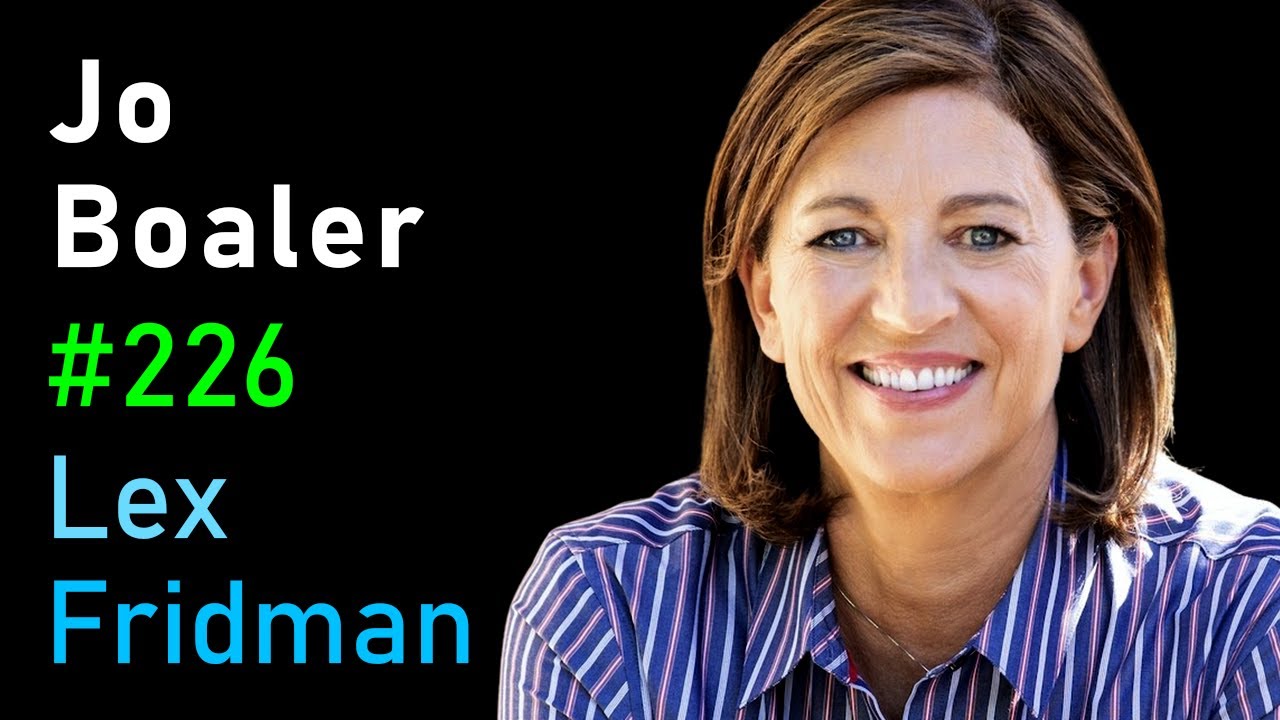
Jo Boaler — A mathematics education professor at Stanford and co-founder of youcubed.org, which provides research-based tools to make math creative and accessible. She is the author of Limitless Mind and a co-writer of California's new math framework.
The gist
Jo Boaler makes the case that math is fundamentally a creative, visual, multi-dimensional subject rather than a single method with one right answer. She explains the neuroscience of learning math across multiple brain pathways, why struggle is good for the brain, and how the harmful belief that you either have a 'math brain' or you don't holds students back. The conversation covers the power of a single teacher's words, the value of collaboration over competition, grades versus deep learning, and teaching to 'big ideas' instead of fragmented standards. Boaler and Lex also discuss online education, visualization tools like Grant Sanderson's work, and the rise of data science as a high school alternative to algebra 2.
Big reveals
- A single sentence on student essays, 'I'm giving you this feedback because I believe in you,' made students perform significantly better a full year later.
- Fields Medalist Maryam Mirzakhani did entirely visual math, and was told at age 13 by a teacher that she couldn't do math.
- Boaler challenges the 'work hard and anyone can get there' ideal, noting some students fail simply for lack of access to good teaching.
- A study found parents' math anxiety predicted their children's lower achievement, but only if the parents helped with homework.
- Boaler recounts a teacher shutting down her question ('that's your question?'), making her stop asking questions in class for years.
- A survey found students on average give up on a math problem after just two minutes.
- Data science is now an accepted high school course replacing algebra 2, changing content set in 1892 that hadn't changed since.
Things worth remembering
- Neuroscience shows there are five brain pathways involved in math, and high achievers have more connections between them.
- 'Groupitizing' (how you visually group dots) predicts how well you do in math better than speed tests.
- At Stanford summer camps, kids were so engaged in math patterns during three-hour sessions they didn't want breaks or lunch.
- Stanford undergrads taught to collaborate on calculus improved their achievement versus working individually.
- Youcubed.org has had over 52 million visitors since launching about five years ago.
- A free six-session, 15-minute online class 'How to Learn Maths' made kids 68% more engaged and improved year-end results.
- Boaler's first free MOOC on math education drew 30,000 math teachers in its first summer.
- In England math is plural ('maths') reflecting its many sub-disciplines; the US shortened it to singular 'math'.
Recommended in this episode
Books, products and media the guest or host genuinely endorsed here — with the buy link.
Affiliate link — we may earn a commission at no extra cost to you.
Limitless Mind
Jo Boaler
“is uh you talk about creativity a little bit and flexibility in your book limitless what's the role of that” — Lex Fridman 00:40:48Find it on Amazon
Elastic: Flexible Thinking in a Time of Change
Leonard Mlodinow (inferred)
“there's a book i like a lot but i've been by physicists you probably know this book could elastic you might know it” — guest 00:41:49Find it on Amazon
Manim
Grant Sanderson (3Blue1Brown)
“he created a library called manum and he open-sourced it and that library is the uh people should check it out it's written in python” — Lex Fridman 01:16:08Find it on Amazon