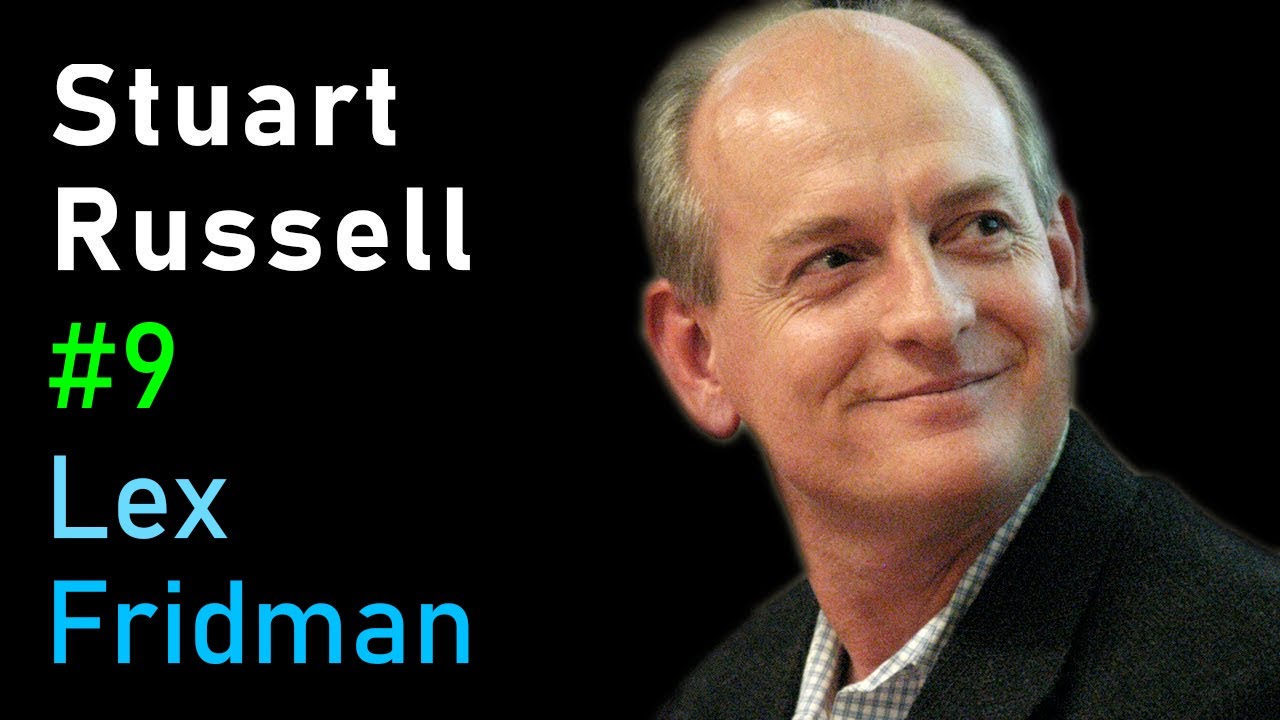
Stuart Russell — Professor of computer science at UC Berkeley and co-author of the foundational textbook Artificial Intelligence: A Modern Approach.
The gist
Stuart Russell traces his path from writing chess programs in high school to studying meta-reasoning, the technique of reasoning about which parts of a search tree to explore that powers systems like AlphaGo. He explains why self-driving cars remain hard, requiring many orders of magnitude more reliability and game-theoretic modeling of human intent rather than rule-based or end-to-end approaches. The core of the conversation is the AI control problem: the danger of building optimizing machines with fixed, mis-specified objectives, illustrated through the King Midas story. Russell argues the solution is provably beneficial AI that is deliberately uncertain about the true human objective, making it deferential and willing to be corrected. He also warns of misuse, overuse leading to human dependence, the absence of regulatory oversight, and parallels with the early denial around nuclear weapons.
Big reveals
- AlphaGo can play at a professional level even with all look-ahead search disabled, relying purely on its position-evaluation intuition.
- The first self-driving car drove itself on the freeway, changing lanes and overtaking, back in 1987.
- Russell frames the central control problem as machines pursuing objectives not aligned with human objectives, the King Midas problem.
- His key proposal: machines should be uncertain about the objective, which makes them humble and deferential to humans.
- Click-through optimization maximizes profit by modifying people to make them more predictable, pushing them toward extremes.
- The day after Rutherford called atomic energy 'moonshine' (Sept 11 1933), Leo Szilard invented the nuclear chain reaction.
- Russell names overuse, the WALL-E problem of humans becoming dependent passengers, as a third major AI failure mode.
Things worth remembering
- Russell's first chess program at Imperial College got only three seconds of CPU time per move after card loading.
- A five-year PhD commitment amounts to roughly a trillion motor-control steps a person eventually carries out.
- A taxi driver doing eight hours a day for ten years logs about a hundred million seconds of driving, demanding eight nines of reliability.
- A game-theoretic driving system invented backing up slightly at a stop sign on its own to signal other cars to go.
- The 1970s Lighthill report dismissively claimed AI researchers were frustrated men seeking to create life as a replacement for children.
- Russell argues we have an FDA for pharmaceuticals because of scalability but zero equivalent oversight for algorithms affecting billions.
- Frederick Soddy predicted in 1915 a new explosive equal to 150 tons of dynamite, which turned out to be about right.
- Russell estimates civilization's knowledge took about a trillion person-years to propagate through human minds.
- E.M. Forster's 1909 story The Machine Stops anticipated iPads, video conferencing, MOOCs, and tech-induced obesity.
Recommended in this episode
Books, products and media the guest or host genuinely endorsed here — with the buy link.
Affiliate link — we may earn a commission at no extra cost to you.
Artificial Intelligence: A Modern Approach
Stuart Russell
“a co-author of a book that introduced me and millions of other people to the amazing world of AI called artificial intelligence a modern approach” — Lex Fridman 00:00:00Find it on Amazon
Artificial Intelligence: A Modern Approach
Stuart Russell
“I showed up University of Illinois to an AI lab and they said okay I don't have time for you but here's a book AI a modern approach” — Lex Fridman 00:16:56Find it on Amazon
The Machine Stops
E.M. Forster
“there's an amazing short story that I recommend to everyone that I talk to about this called the machine stops written in 1909 by Ian Foster” — guest 01:20:18Find it on Amazon
Interstellar
Christopher Nolan (inferred)
“I would say interstellar has my favorite robots... tars the robots one of the robots in interstellar is the way a robot should behave” — guest 01:25:33Find it on Amazon