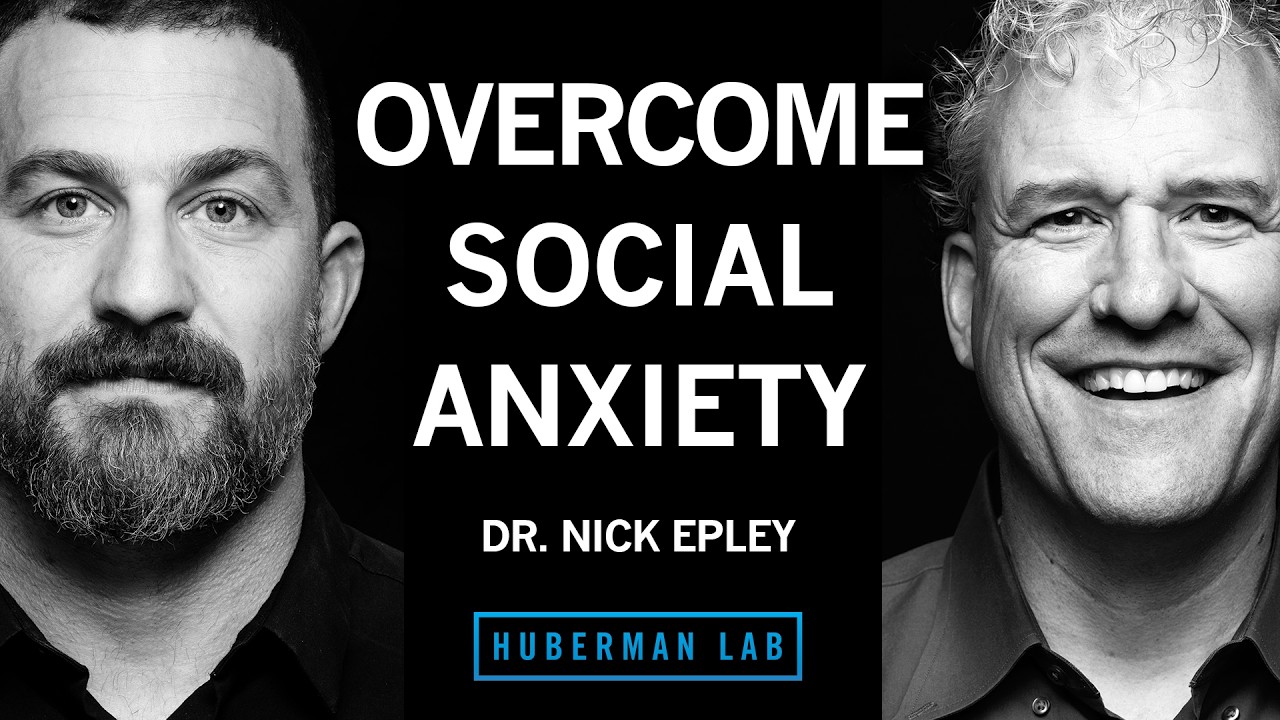
Dr. Nick Epley — A behavioral scientist at the University of Chicago and a leading researcher on the science of social connection. Author of the forthcoming book 'A Little More Social' and known for studies on how people underestimate the rewards of reaching out to others.
The gist
Andrew Huberman and Nick Epley explore how humans infer other people's minds through their eyes, voice, and behavior, and the predictable errors those inferences create. The core thread is that people are systematically too pessimistic about how strangers will respond to them, missing countless small chances to connect that would measurably boost mental and physical health. Epley argues well-being is built from small positive moments rather than rare peak experiences, and that exposure to misplaced social fears works by changing your beliefs about others, not by dulling anxiety. The conversation ranges widely into AI and voice, loneliness and isolation, the role-driven nature of love (illustrated by Epley adopting children, including a daughter with Down syndrome), and modeling good social habits for kids.
Big reveals
- Being alone for a day hurts well-being about seven times more than the gap of a $60,000 difference in income.
- Extraversion correlates with day-to-day happiness at roughly .5, as strong as the height correlation between fathers and sons.
- Exposure therapy for social anxiety works not by reducing fear but by changing your beliefs about how kind other people actually are.
- In Jia Jiang's '100 days of rejection,' he was accepted ~51 times and rejected ~48, with negativity in only about 7 of 100 attempts.
- Epley reveals his youngest daughter Lindsey, adopted from China, has Down syndrome and describes her as a 'unicorn' who flips a switch in everyone she greets.
- Epley admits his initial pessimism about raising a child with Down syndrome, and that calling other families changed his mind before they adopted.
- The couple lost a biological daughter, Sophie, to stillbirth at six months before deciding to adopt Lindsey.
- Epley says when he and his wife committed to adopting their first children, the kids visually 'looked different' and better to them in that instant.
Things worth remembering
- A 2008 'cultural intelligence' study found human toddlers, chimps, and orangutans score equally on physical IQ tasks, but toddlers crush them on social ones.
- Humans can detect the angle of someone's gaze instantly from far away despite being terrible at calculating physical angles.
- Hearing a political opponent's voice (vs. reading their text) makes people rate them as more thoughtful and human, reducing dehumanization.
- The pop-psych claim that 80% of communication is nonverbal is a distorted, overstated experimental result.
- The social brain hypothesis links neocortex size to the social complexity of a primate species' group.
- In economic games, people give away 30-50% of money to strangers, defying the self-interest predictions of standard economic theory.
- The 'underestimation of compliance effect' shows people overestimate how many strangers they must ask to get help.
- People who help you feel better than you expect, because being kind to others makes us happier.
- Epley notes recent upswings in church and gathering attendance, partly attributed to post-pandemic craving for in-person connection.
- Epley's personal habit: a 'hello walk' from the office door, greeting everyone he passes, to brighten his own mood.
Recommended in this episode
Books, products and media the guest or host genuinely endorsed here — with the buy link.
Affiliate link — we may earn a commission at no extra cost to you.
A Little More Social: How Small Choices Create Unexpected Happiness, Health, and Connection
Nick Epley
“thank you for writing the book, A Little More Social, How Small Choices Create Unexpected Happiness, Health, and Connection, which comes out very soon.” — Andrew Huberman 02:26:01Find it on Amazon