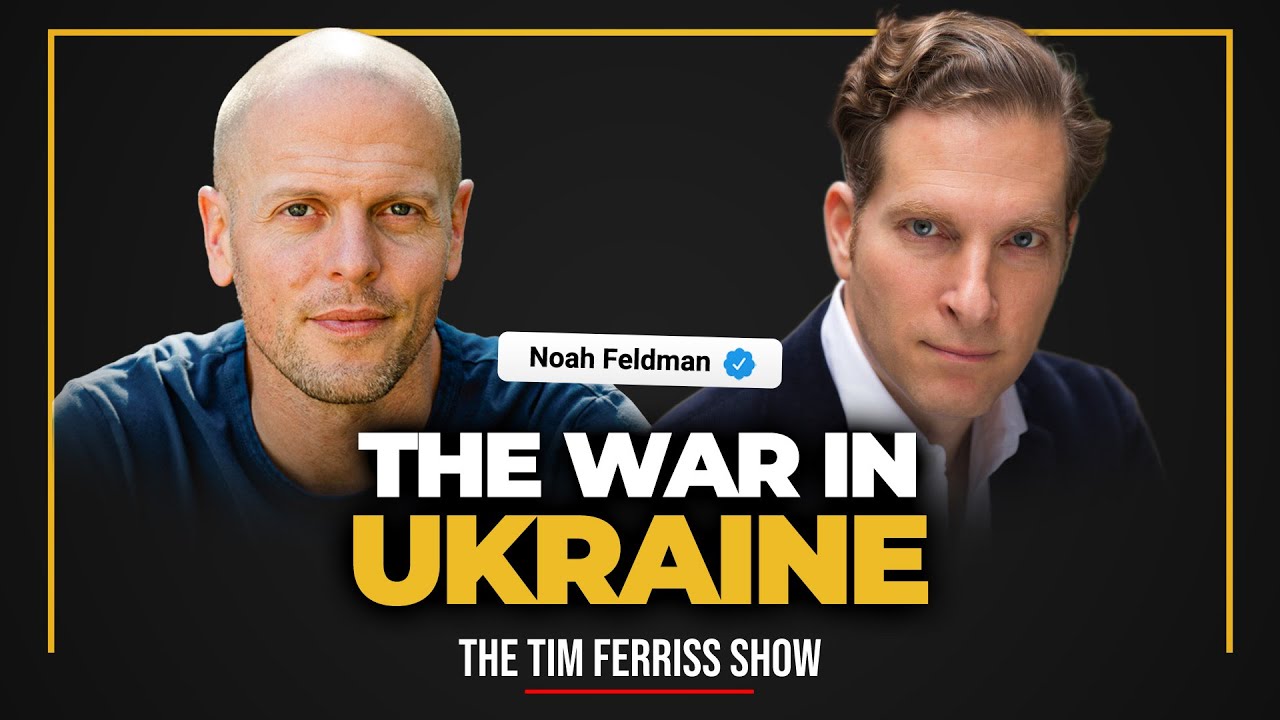
Noah Feldman — Harvard Law professor, constitutional scholar, and free-speech expert who helped build Meta's Oversight Board and advises social media companies including TikTok.
The gist
In this experimental current-events episode, Tim Ferriss and Noah Feldman explore why nations choose war, using the Russia-Ukraine conflict as a lens on whether leaders like Putin act rationally. Feldman walks through game-theory explanations for fighting against the odds, the limits of economic sanctions and asset freezes, and the risks of weaponizing the US dollar's reserve status. The conversation then pivots to free speech on social media, unpacking the difference between the everyday and constitutional definitions of free speech and the embarrassing 180-degree flip both liberals and conservatives have made on content moderation. They close with speculation about web 3.0, decentralization, and how augmented and virtual reality could make today's split between government and private regulation unsustainable.
Big reveals
- Feldman explains political scientist James Fearon's theory that rational actors still go to war when the two sides hold different private information about who will win, which he thinks partly explains why Putin attacked and Ukraine resisted.
- Feldman argues crypto can't protect wealth from a ruler like Putin because imprisonment defeats it: 'they won't let you out of prison unless you give them the key to your wallet.'
- He voices a genuine worry that even if Ukraine wants to settle and cede the two provinces, the West may refuse to let them stop because of the message it sends, prolonging the war beyond what Ukrainians want.
- Feldman flags freezing Russia's dollar assets and forcing a sovereign-debt default as 'super high risk,' warning it could eventually erode confidence in the US dollar as the world's reserve currency.
- He distinguishes the ordinary meaning of free speech (saying what you want) from the narrow constitutional definition, where only the government, not a private social media company, can violate your First Amendment rights.
- Feldman calls it an 'embarrassing' 180-degree flip that liberals abandoned their distrust of corporate speech control to embrace content moderation while conservatives reversed to demand the platforms be regulated like common carriers.
- He states that hate-speech law was invented in post-WWII Europe specifically to suppress certain political views, designed to stop Nazi-style ideas from gaining a foothold that could lead to power.
- Feldman shares a not-previously-stated insight: a mixed AR/VR world makes it unsustainable to have two regulatory regimes at once, government rules for real life and private-company rules for the virtual layer, when you interact with the same person in both simultaneously.
Things worth remembering
- In 1939 the Polish cavalry, still on horseback, charged German tanks and lasted less than an hour, an act Feldman frames as honor over rational survival.
- FDNY chief Ray Downey, who founded Rescue 1 to save endangered firefighters, went back into the World Trade Center towers on 9/11 knowing he likely would not come out.
- Ukraine launched a 'Ukraine DAO' to channel cryptocurrency donations directly to the country, bypassing banks, though Feldman says it was statistically a drop in the bucket of total aid.
- Early in the war, supporters booked Airbnbs in Ukraine they never intended to use as a way to funnel money to hosts as donations.
- Feldman calls Carl von Clausewitz's 'On War' the most influential book on war since Sun Tzu's 'Art of War' and required reading at military academies worldwide.
- He recommends Yale historian Timothy Snyder, whose major book 'Bloodlands' covers the wars of the 20th century with Ukraine at the geographic center.
- Tim cites Edward Luttwak's 'Coup d'Etat: A Practical Handbook' (1968), translated into 16 languages and reportedly read widely by Chinese military and officials.
- Feldman wrote a 2013 book titled 'Cool War' about US-China relations, arguing the two would diverge geopolitically while staying economically intertwined, short of actual war.
- Feldman notes the concept of the 'Thucydides Trap' was raised by a senior Harvard strategist questioning whether the US and China would inevitably go to war.
- Tim cites a study finding that merely having your phone in the room, even powered off and unused, measurably makes you perform worse on cognitive tests.
Recommended in this episode
Books, products and media the guest or host genuinely endorsed here — with the buy link.
Affiliate link — we may earn a commission at no extra cost to you.
On War
Carl von Clausewitz
“so I would strongly recommend that book I can't actually recommend it strongly enough it really makes you think” — Noah Feldman 00:43:22Find it on Amazon
Bloodlands
Timothy Snyder
“I would strongly recommend any of his books his grand book is called bloodlands it's long and intense but it's very very very beautifully and clearly written” — Noah Feldman 00:45:25Find it on Amazon
Cool War
Noah Feldman (inferred)
“about 10 years ago I wrote a book about u.s and china which was called cool war which I thought was like the best title of any book title I've ever come up with” — Noah Feldman 00:47:58Find it on Amazon