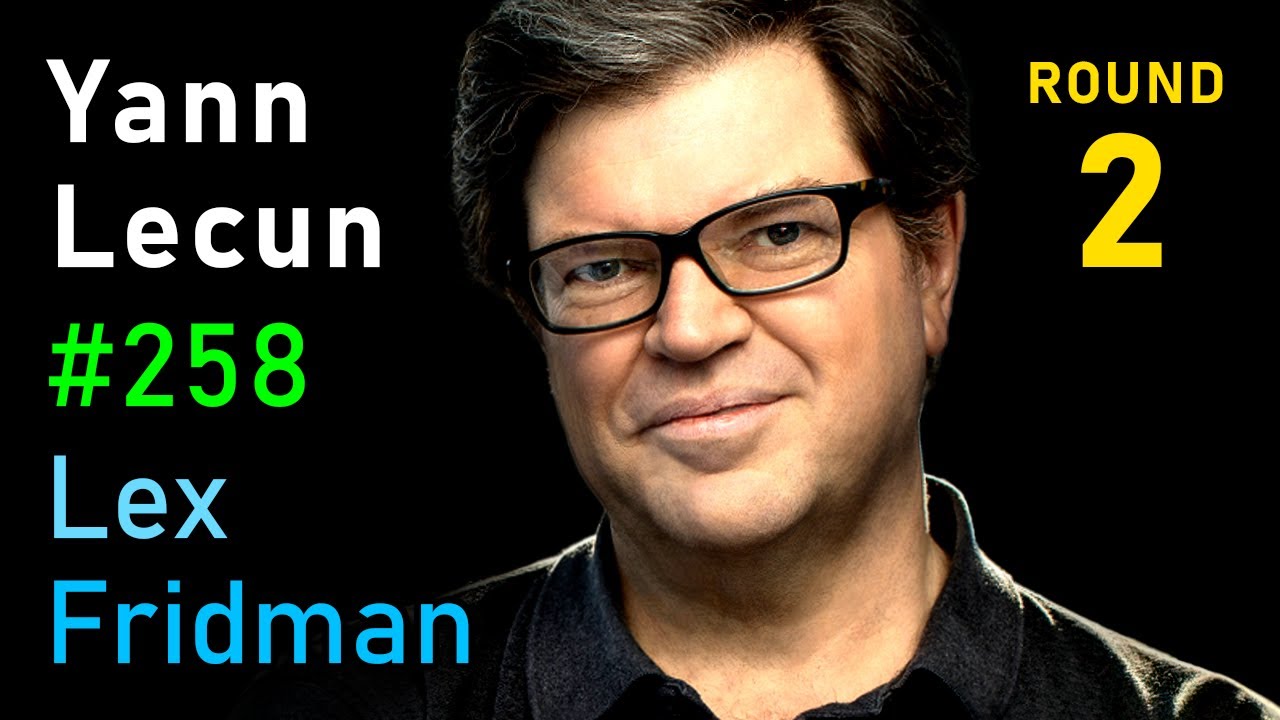
Yann LeCun — Chief AI Scientist at Meta (formerly Facebook), NYU professor, and Turing Award winner. One of the seminal figures in deep learning and modern machine learning.
The gist
Yann LeCun explains why supervised and reinforcement learning are too inefficient to reach human-level intelligence and why self-supervised learning, which lets systems learn by predicting and filling in the blanks, is our best shot at building world models. He details the technical challenge of representing uncertainty in video prediction and champions non-contrastive joint-embedding methods like VICReg and Barlow Twins. The conversation ranges into consciousness as a limitation of a single world-model engine, emotions in autonomous machines, and the ethics of robot rights. LeCun also defends Facebook/Meta against claims it drives polarization, critiques the academic peer-review system, and shares personal passions for electronic wind instruments and model airplanes.
Big reveals
- LeCun says supervised and reinforcement learning are so inefficient that's why we still don't have real self-driving cars.
- Self-supervised learning works great for language but nobody has succeeded at learning to represent the visual world from video.
- Our most intelligent AI systems don't have as much common sense as a house cat, which runs on under a billion neurons.
- He calls VICReg the thing he is most excited about in machine learning in the last 15 years.
- LeCun's speculative theory: consciousness is a consequence of the limitation of our brains having only one world-model engine, not their power.
- He argues any truly autonomous intelligent machine will necessarily have emotions like fear and elation.
- LeCun defends Meta, citing independent academic studies showing Facebook does not cause political polarization.
- He proposes replacing journals and conferences with public reviewing entities whose reputation rises when their evaluations predict future success.
Things worth remembering
- In reinforcement learning the world gives the machine only a single scalar reward, whereas a video clip gives an enormous amount of predictive signal.
- A cat's brain has under one billion neurons and a dog's about two billion, and almost all of it is learned via self-supervision.
- LeCun co-invented contrastive learning in the early 90s at Bell Labs for a credit-card signature verification project.
- No text in the world explains that an object on a table moves when you push the table, so language-only models can never learn it.
- Expertise like a chess grandmaster's moves from deliberate world-model reasoning into automatic subconscious pattern recognition.
- When the printing press let people read the Bible themselves, it helped spark 200 years of religious wars, far worse than social media.
- Heinz von Foerster's self-organization example: magnets shaken in a zero-gravity box spontaneously form complex structures.
- LeCun says efficiently separating hydrogen from oxygen with electricity would essentially solve climate change.
- Stacking two graphene layers twisted by about three degrees makes a superconductor and nobody knows why.
Recommended in this episode
Books, products and media the guest or host genuinely endorsed here — with the buy link.
Affiliate link — we may earn a commission at no extra cost to you.
Self-Supervised Learning: The Dark Matter of Intelligence
Yann LeCun and Ishan Misra
“you co-wrote the article self-supervised learning the dark matter of intelligence great title by the way with ishan mizrah” — Lex Fridman 00:00:32Find it on Amazon