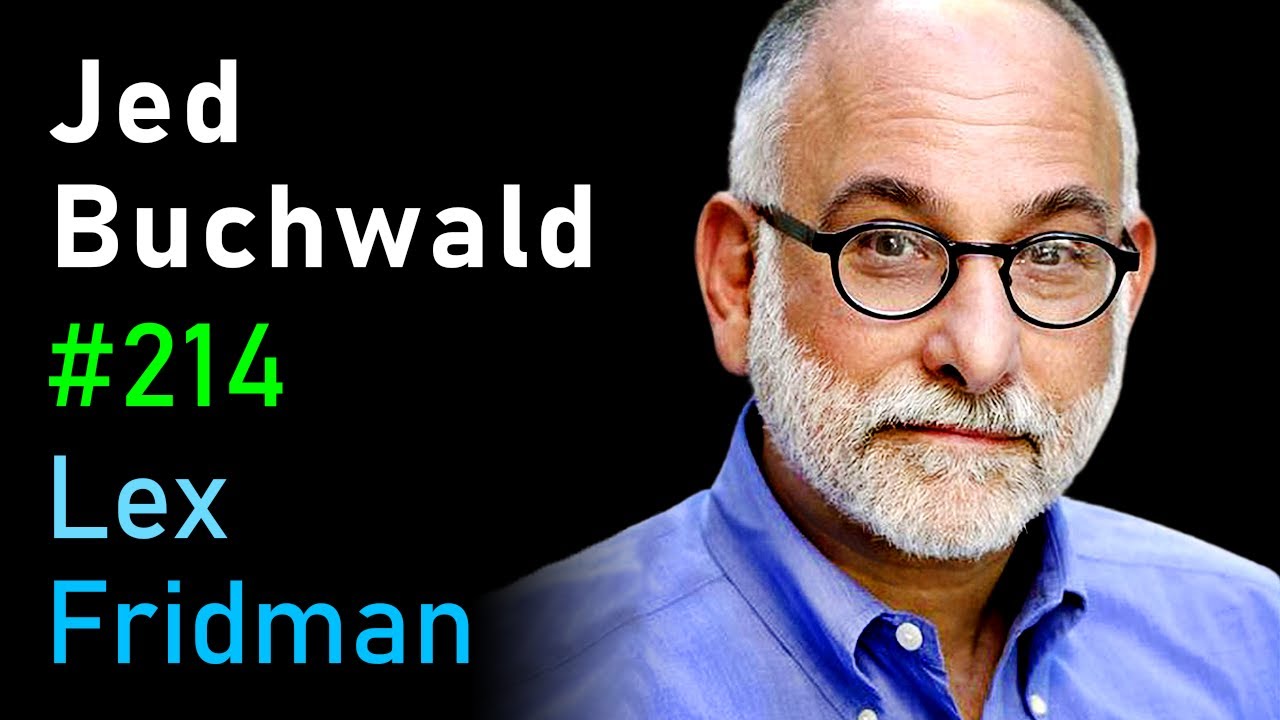
Jed Buchwald — A professor of history and philosopher of science at Caltech specializing in how scientific concepts and instruments develop. He was Thomas Kuhn's research assistant and is a leading authority on the history of optics and Isaac Newton.
The gist
Jed Buchwald discusses how science actually progresses, challenging Thomas Kuhn's clean model of paradigm shifts in favor of a messier picture where new theories win by enabling new experiments and devices rather than simply explaining old anomalies. The conversation centers on Isaac Newton, his work on light and prisms, his invention of calculus, his alchemy, his religious beliefs, and his combative personality. Buchwald argues experimental science is fundamentally about manipulating nature with artificial instruments, and that human perception is an unreliable construct that science must work around. They also explore feuds among scientists (Newton vs. Hooke, Newton vs. Leibniz, Arago vs. Biot), the role of data and statistics, and whether genius like Newton's or Einstein's is inevitable.
Big reveals
- Buchwald disagrees with his mentor Kuhn, arguing wave theory beat Newton's particle theory not because Newton failed but because the wave theory let scientists generate new devices and mathematics.
- Buchwald declares he is not a scientific realist, doubting we can ever truly probe the deepest workings of nature, and explicitly disagrees with Stephen Weinberg.
- Newton stuck a stick under his own eyeball and pushed on it to study color perception, an experiment Buchwald tells students never to repeat.
- The famous Newton-and-the-apple story is essentially false; a colleague joked the role of fruit in science history is vastly exaggerated.
- A scholar found a Leibniz manuscript suggesting Leibniz reverse-engineered Newton's Principia to get his results, though most historians of math disagree.
- Newton, despite his genius, believed creation happened about six thousand years ago and was an anti-Trinitarian who doubted most biblical miracles.
- Hooke's eye-acuity experiment was right and wrong at once: he measured 20/20 static vision but missed that the eye detects motion far more sharply, vindicating Hevelius.
Things worth remembering
- Christiaan Huygens deployed Galileo's relationships to build the first pendulum-governed clock and was one of the two greatest scientists of the 17th century alongside Newton.
- Glass prisms in the 1660s were sold as crude novelties at English county fairs, full of bubbles, valued for the colors they produced.
- Newton set his prism by hand by exploiting the angle where the image moves slowest, using mathematical insight to beat measurement inaccuracy.
- Buchwald recalculated Hevelius's star positions with modern NASA tables and found them even more accurate than Hevelius himself had claimed.
- As Master of the Mint, Newton hunted counterfeiters and sent at least one, named Chaloner, to the gallows.
- The three-body problem cannot be solved exactly; the full techniques came only 30-40 years after Newton's death from French mathematicians like Laplace.
- The moon repeats its observable position among the stars only every 19 years, a fact discovered by the Babylonians thousands of years ago.
- Before modern statistics, Huygens and others published a single number they trusted most rather than averaging repeated measurements.
- After Einstein died his brain was sliced up and examined, but nothing visibly unusual was found.
- Newton spent the late 1670s working more on alchemy than anything else, producing a shiny 'star regulus' later reproduced by historians.
Recommended in this episode
Books, products and media the guest or host genuinely endorsed here — with the buy link.
Affiliate link — we may earn a commission at no extra cost to you.
The origins of the wave theory of light (book by Jed Buchwald)
Jed Buchwald
“i once wrote a book on the origins of wave theory of light and that is one of the paradigmatic examples that tom used” — Jed Buchwald 00:02:39Find it on Amazon