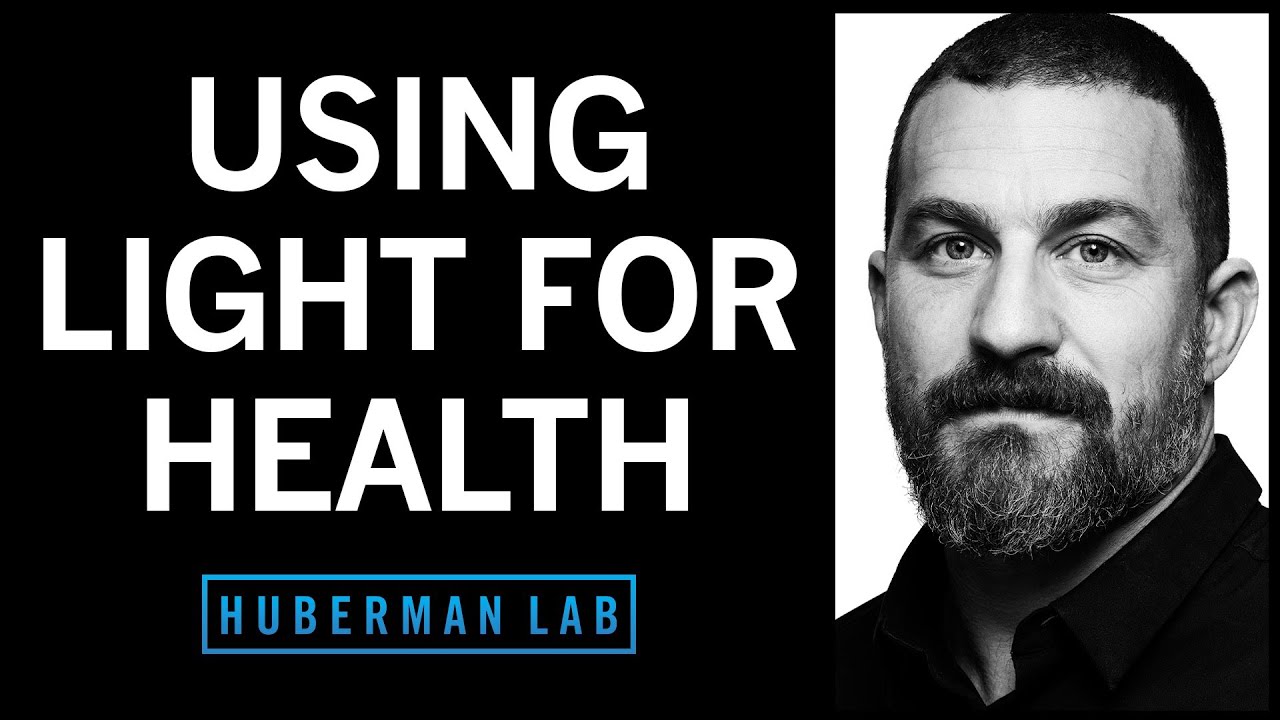
Andrew Huberman — Professor of neurobiology and ophthalmology at Stanford School of Medicine and host of the Huberman Lab Podcast, where he translates peer-reviewed science into actionable health protocols.
The gist
In this solo episode, Huberman explains the physics and biology of light, showing how different wavelengths penetrate tissues to different depths and are absorbed by photoreceptors, melanocytes, and mitochondria. He details how light controls melatonin and circannual rhythms, and reviews studies showing UVB skin and eye exposure raises testosterone and estrogen, boosts mating desire, reduces pain via endogenous opioids, and enhances immune and spleen function. He then covers red and near-infrared low-level light therapy for skin healing and for reversing age-related vision loss, plus emerging 40 Hz flickering-light work for offsetting cognitive decline. Throughout he gives specific protocols and strong cautions about eye safety and nighttime light exposure.
Big reveals
- A 2021 Cell Reports study found UVB skin exposure triggers a skin-brain-gonad axis, raising testosterone and estrogen and increasing mating behavior in mice and humans.
- Testosterone increases from UVB were significantly larger in men from low-UV countries and in people with paler skin.
- UVB exposure releases beta-endorphins and, via a periaqueductal gray circuit, raises pain tolerance.
- Huberman warns that UVB light between 10pm and 4am activates the perihabenular pathway, suppressing dopamine and worsening mood.
- A PNAS study showed even one night sleeping in a 100-lux room raised heart rate and insulin resistance without altering melatonin.
- Glen Jeffery's lab showed 670nm red light viewed 2-3 minutes each morning improved visual acuity 22% in people over 40.
- Li-Huei Tsai's MIT work shows 40 Hz flickering light entrains gamma brain waves and reduces amyloid plaques and tau.
- Red/near-infrared light therapy was able to reduce or reverse drusen, the cholesterol deposits that accumulate in the aging eye.
Things worth remembering
- In 1903 the Nobel Prize went to Niels Finsen for using phototherapy to treat lupus, over a century of light-therapy science.
- The rods and cones of the retina are the most metabolically active cells in the entire body.
- The neural retinas are the only two pieces of your brain that reside outside the cranial vault.
- The body runs a circannual calendar using melatonin duration to track where you are in the 365-day year.
- You don't catch fewer colds in summer because there's less infection around; your spleen and immune system simply combat it better.
- Hair, skin, and nails grow and turn over faster in longer days, triggered by UVB exposure to both skin and eyes.
- Even on a cloud-covered day you get far more light energy through the clouds than from any indoor artificial source.
- Most car windshields and windows filter out UVB light, so you won't get the benefits through glass.
- Retinal neurons do not regenerate; once dead they cannot be replaced, so never look at painfully bright light.
- For shift work or all-nighters, dim red light keeps you alert without suppressing melatonin or raising nighttime cortisol.
Recommended in this episode
Books, products and media the guest or host genuinely endorsed here — with the buy link.
Affiliate link — we may earn a commission at no extra cost to you.
LED lighting drawing light panel (930-1000 lux)
“This is a 930 to 1,000 lux, L-U-X, light source that's designed for drawing. It's literally a drawing box. It's a thin panel.” — Andrew Huberman 01:17:03Find it on Amazon
Light Meter app
“I would encourage you to download the free app Light Meter. I have no relationship to the app. It's a pretty cool app, however.” — Andrew Huberman 01:33:22Find it on Amazon