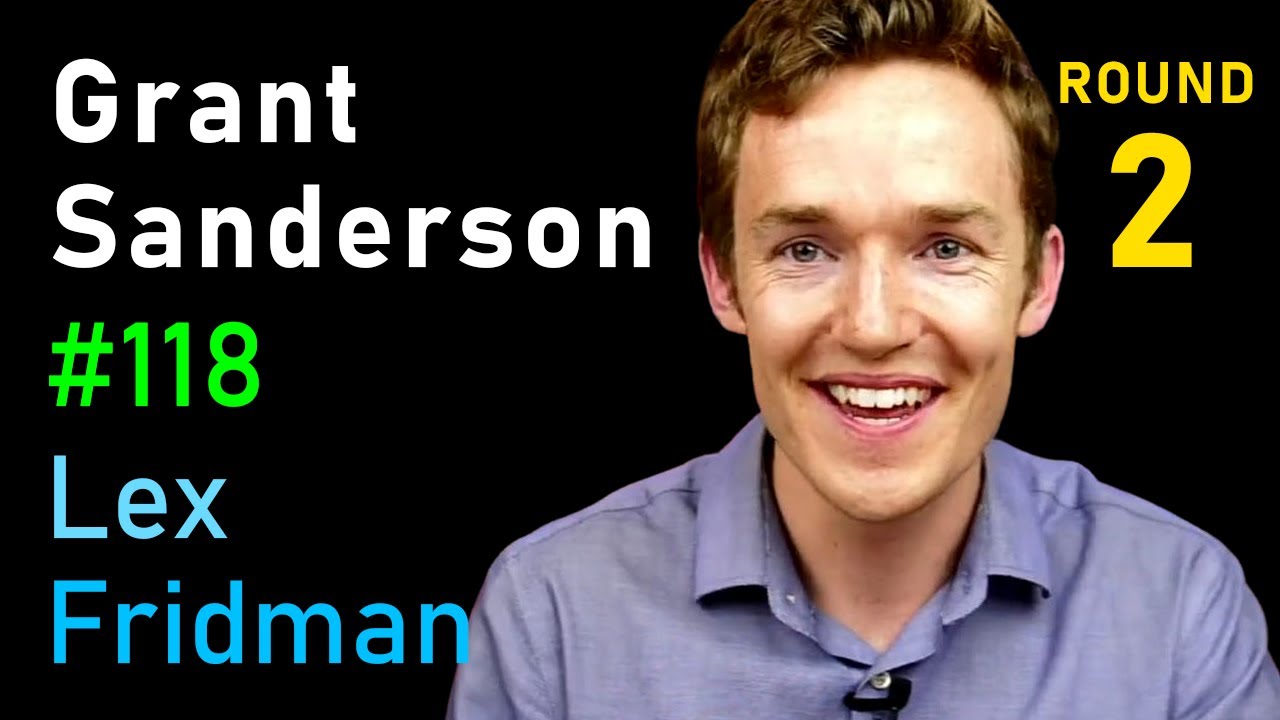
Grant Sanderson — Creator of the YouTube channel 3Blue1Brown, where he teaches math through striking visualizations using his own Python animation library, Manim. Known to millions for making difficult mathematical concepts intuitive and beautiful.
The gist
In his second appearance on Lex Fridman's podcast, Grant Sanderson explores what made Richard Feynman special and the limits of the satisfying-but-non-sticky 'Feynman effect' in teaching. He digs into intuitions about exponential growth, why Moore's law may be S-curves rather than true exponentials, and the value of hard deadlines for driving innovation. He reflects candidly on the loneliness of solo creative work, his writing process, and the psychology of YouTube comments. The conversation closes with neural networks, GPT-3's strengths and weaknesses, his philosophy on Manim and teaching tools, and an argument that popular science should focus on reachable beauty rather than theories of everything.
Big reveals
- Grant admits he is 'not an active researcher' because his deep-learning-style rediscovery approach 'really slows you down.'
- Asked if his singular solo work gets lonely, he calls it 'the biggest part of my life that I would like to change,' envying the Bell Labs collaborative environment.
- He confesses he actually prefers solitary work and that scripting/writing is the worst, most procrastinated-on part of his process.
- Reveals Joe Rogan's full-length videos are being removed from YouTube as part of the Spotify deal, shattering his belief that 'YouTube is forever.'
- Admits he still feels impostor syndrome every time he posts a video, even on topics he knows deeply.
- Contrarian claim: audiences are 'more interested in theories of everything than they should be' and popularizers should be less emphatic about them.
- States plainly that he doesn't think life has a meaning, reframing the question as one that only applies to things created with intent.
Things worth remembering
- Feynman wrote a heartfelt love letter to his wife two years after she died, revealing a side hidden behind his 'aw shucks' public image.
- The 'Feynman effect': his lectures feel perfectly clear in the moment, but you often can't recall the insight a week later.
- In some societies without numeracy, the number 'between' 1 and 9 is intuitively 3, because humans naturally think logarithmically.
- A lily pad doubling daily that covers a lake in 50 days covers only half the lake on day 49 and about 1% around day 44.
- The ARPANET was funded during the Vietnam War partly because packet switching offered a communication system resilient to a city being nuked.
- In convolutional nets, early layers detect low-level textures while later layers recognize high-level concepts like eyes or whole animals.
- Seeded with a COVID-like prompt, GPT-3 generated a month-by-month zombie apocalypse that was eerily plausible before spiraling out of hand.
- The pattern 1, 2, 4, 8, 16 from dividing a circle with chords breaks at the next term, which is 31, not 32.
- Manim was rewritten to use GLSL shaders so 3D scenes can render live and interactively while Grant codes them.
Recommended in this episode
Books, products and media the guest or host genuinely endorsed here — with the buy link.
Affiliate link — we may earn a commission at no extra cost to you.
Peak
Anders Ericsson (inferred)
“a good book to read if you want that sense is peak which essentially talks about peak performance in a lot of different ways” — guest 00:38:34Find it on Amazon