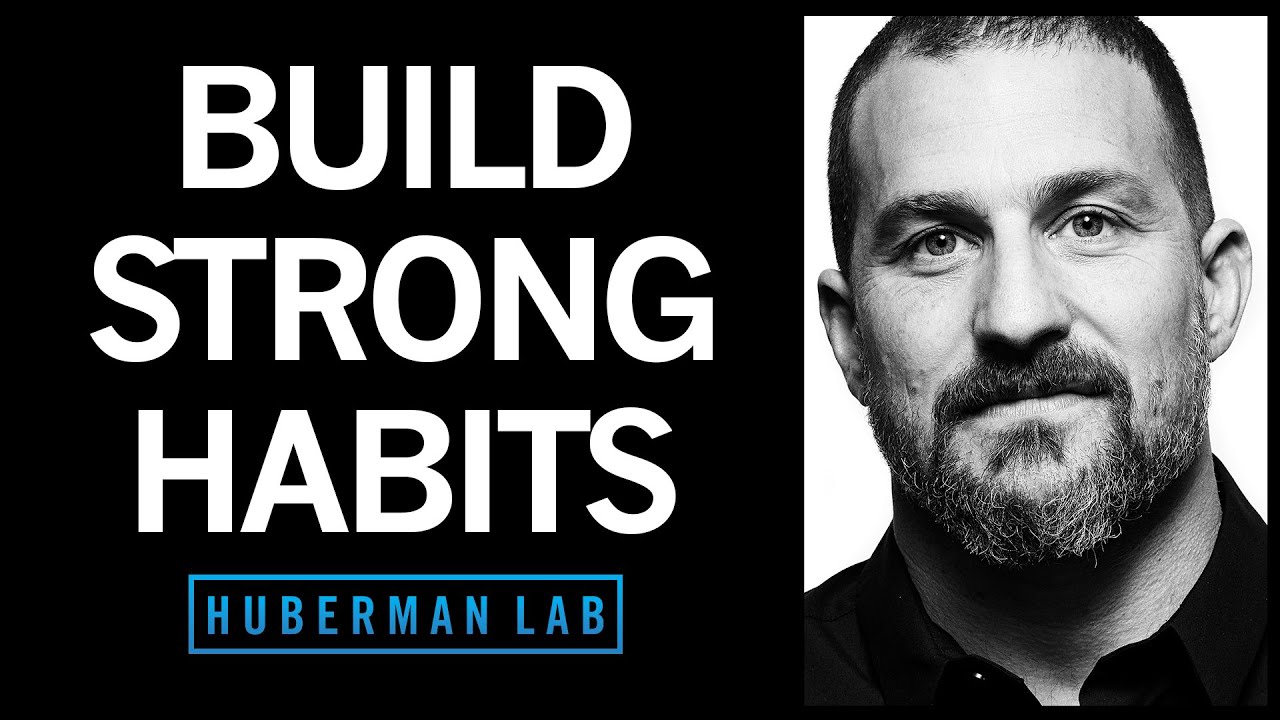
Andrew Huberman — Professor of Neurobiology and Ophthalmology at Stanford School of Medicine and host of the Huberman Lab Podcast, known for translating neuroscience into practical everyday tools.
The gist
In this solo episode, Andrew Huberman explains the biology and psychology of how habits form and break, introducing concepts like limbic friction, linchpin habits, task-bracketing, and reward prediction error. He outlines a phase-based daily framework that places hard habits in the action-oriented morning (phase one), calmer habits in the afternoon (phase two), and consolidation during deep sleep (phase three). He presents a 21-day program of attempting six new habits per day while expecting to complete only four or five, with permission to fail. For breaking habits, he explains long-term depression and the counterintuitive tool of appending a positive replacement behavior immediately after a bad-habit slip.
Big reveals
- Cites the 2010 Lally study showing it can take anywhere from 18 to 254 days to form the same habit, debunking the 21-day myth.
- Admits 'limbic friction' is a term he coined himself, not found in the formal neuroscience or psychology literature.
- Recommends placing your hardest, highest-friction habits in phase one (0-8 hours after waking) when dopamine and adrenaline are naturally elevated.
- Contrarian claim: being rigid about exact times of day actually makes people less likely to stick to habits long-term; anchor to state, not the clock.
- Presents a 21-day program where you list six habits but are expected to only complete four or five, building 'the habit of performing habits.'
- The key to breaking a habit is engaging a positive replacement behavior in the moment immediately AFTER the slip, not before it.
- Notes a meta-analysis finding that reminders and notifications work short-term but fail to predict long-term habit change.
Things worth remembering
- Up to 70% of our waking behavior is estimated to be made up of habitual behavior.
- The basal ganglia run 'go' (do) and 'no-go' (don't do) circuits, and most people are unbalanced toward one or the other.
- The dorsolateral striatum is active at the very beginning and end of a habit, 'bracketing' it rather than running the habit itself.
- If you expect a reward and break your own protocol mid-task, dopamine drops below the baseline you had before starting.
- Most of the dopamine from an anticipated reward arrives during anticipation, not when the reward is actually received.
- Dopamine is a molecule of motivation and drive, not a reward molecule; adrenaline is biochemically manufactured from dopamine.
- A single visualization of the step-by-step procedure of a habit measurably raises the long-term likelihood of performing it.
- Breaking habits relies on 'long-term depression,' a synapse-weakening process unrelated to mood-related depression.