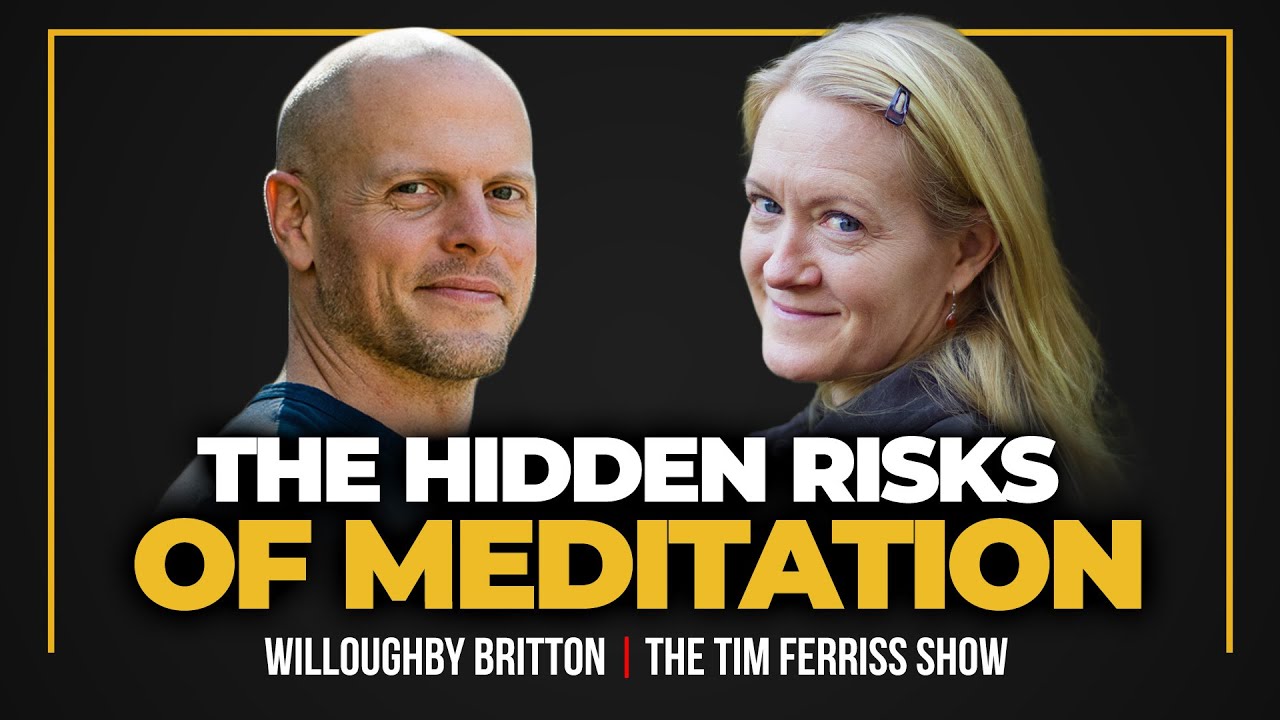
Dr. Willoughby Britton — Clinical psychologist and associate professor of psychiatry at Brown University Medical School, director of Brown's Clinical and Affective Neuroscience Laboratory, and founder of Cheetah House, a nonprofit supporting meditators in distress. Best known for research on meditation's adverse effects.
The gist
Tim Ferriss talks with Dr. Willoughby Britton about the hidden risks and adverse effects of meditation, a topic she has researched for over a decade. Ferriss shares his own harrowing experience at a Spirit Rock Vipassana retreat, where combining fasting, psychedelics, and silence triggered a flooding of childhood trauma memories he could not stop. Britton walks through her research, including the Varieties of Contemplative Experience study that produced a taxonomy of 59 categories of meditation-related challenges across seven domains. They discuss who is most vulnerable, why screening people out doesn't work, the overlap between meditation and psychedelic adverse events, and practical safety approaches like personalized indicator-tracking and 'scaffolding.' The conversation closes with Britton's own pivot away from Vipassana toward nature and physical work, plus a detour into her early near-death-experience research.
Big reveals
- Britton's dissertation found that meditation increased cortical arousal and caused insomnia rather than improving sleep, with a 0.8 correlation to practice amount, and she admits she didn't publish the data because she was an evangelist for meditation.
- A meditation teacher told her 'Everyone knows that if you meditate enough, you stop sleeping,' revealing that teachers hold knowledge about risks they aren't sharing.
- In their epidemiological study, about half of people who ever meditated once had at least one negative effect, and roughly 10 percent (one in 10) had an adverse effect that impaired functioning off the cushion.
- 75 percent of people who ran into problems in the Varieties study had graduate degrees (MD, PhD, JD) or were CEOs, and 60 percent of those with challenges were themselves meditation teachers practicing correctly.
- The average duration of impairment from meditation-related challenges was one to three years, ranging from a few days to more than a decade.
- Certain forms of meditation mimic the exact neurobiology of dissociation, and downregulating the limbic system far enough produces anhedonia, including one meditator who felt nothing for her own children.
- When Britton presented her research to the Dalai Lama at the Mind & Life Dialogues, he was reportedly dismissive and laughing, suggesting the problems happened because people lacked sufficient Buddhist training.
Things worth remembering
- During her clinical residency, two yogis came off retreat completely psychotic in a single year, which sparked the Varieties of Contemplative Experience study.
- The Varieties study took 10 years, produced 3,000 pages of qualitative data, and yielded 59 categories of challenges grouped into seven domains: cognitive, perceptual, affective, somatic, conative, sense of self, and social.
- A documented case: a meditator stopped at a red light, saw the color, but no longer registered that it meant 'stop' due to loss of conceptual meaning structures.
- Britton's team has a whole paper on ELSEs, 'energy-like somatic experiences,' described as electricity or voltage going through the body.
- High-fat, high-protein meals and meat are recommended remedies for ungroundedness on retreats, also found in Tibetan medicine, while retreats typically serve light vegetarian food, the opposite.
- Ferriss combined fasting, silence, and escalating doses of dried psilocybin mushrooms (working up from about 100mg to roughly 600mg) at his retreat, never disclosing the psychedelics to staff.
- Cheetah House began as a halfway house for Brown students wanting to become monastics, and 'Cheetah' is a play on the Sanskrit word 'citta,' meaning mind.
- A near-death-experience subject in Britton's study described future cities made of switchable opaque 'smart glass' decades before Britton saw it herself in a Vermont house, and the subject reportedly came back speaking another language.
- Britton's NDE research found that people who had near-death experiences showed epileptiform hypersynchrony in their brains during sleep, while a control group did not.
- Ferriss's stated minimum bar for serving psychedelics to others: at least 30 to 50 high-dose personal experiences plus volunteering for crisis-tent harm-reduction shifts.
Recommended in this episode
Books, products and media the guest or host genuinely endorsed here — with the buy link.
Affiliate link — we may earn a commission at no extra cost to you.
A Path with Heart
Jack Kornfield
“my dad sent me A Path with Heart by Jack Kornfield, and that became my Bible for the next, probably, decade” — Willoughby Britton 00:03:13Find it on Amazon
Cheetah House online courses
Cheetah House (inferred)
“on the Cheetah House website there's a tab called online courses. If you're a meditation teacher or a clinician, you can actually take the courses” — Willoughby Britton 01:31:35Find it on Amazon