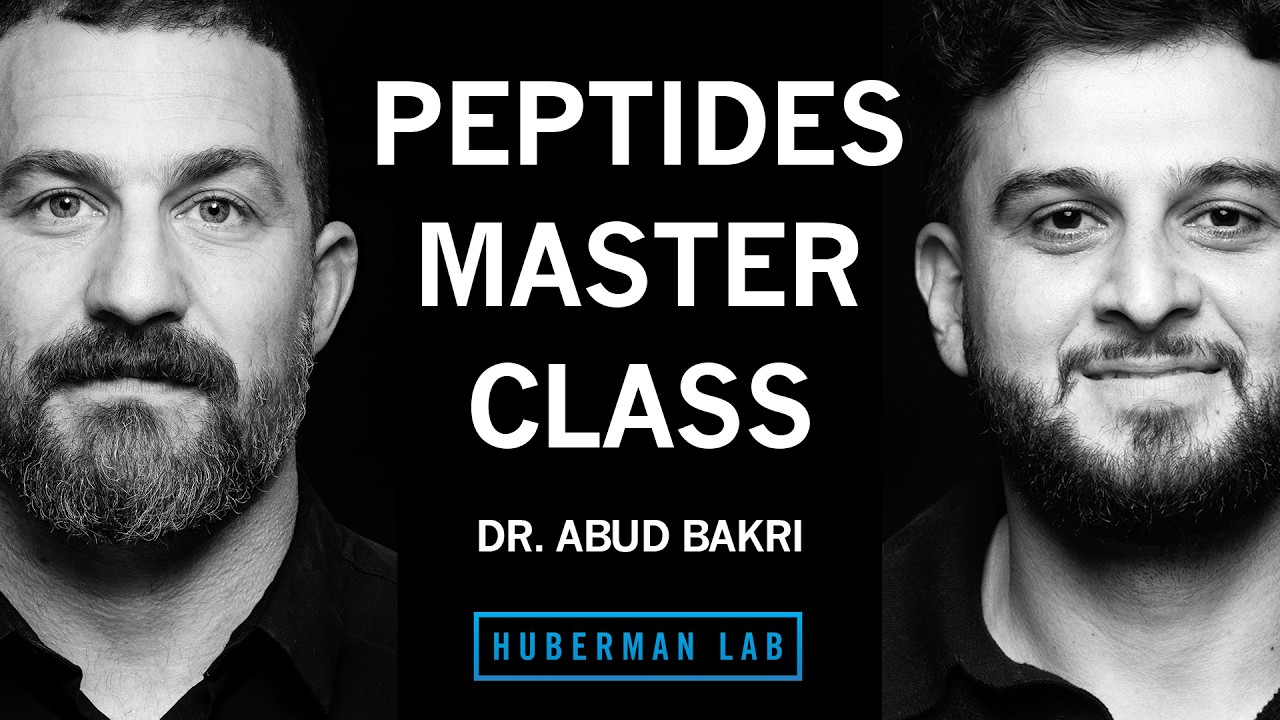
Dr. Abud Bakri — A 33-year-old board-certified internal medicine physician who works hospital wards (ER to ICU) and has encyclopedic knowledge of peptide science, history and safety. He recently released a circadian-biology app.
The gist
Huberman and Dr. Bakri break peptides into categories, chiefly those with known receptors (like GLP-1 drugs) versus those without (like BPC-157), and trace each compound's history, mechanism and evidence base. They cover BPC-157 for tissue/gut repair, the Russian 'bioregulator' peptides epitalon and pinealon, thymic peptides (thymosin alpha-1, TB-500, thymulin) for immunity and aging, GHK-Cu for skin and collagen, and growth-hormone secretagogues. A large portion examines GLP-1s (semaglutide, tirzepatide, retatrutide) for weight loss and metabolic health. Throughout, the discussion stresses that most human data is thin or comes from single labs, that the gray-market supply chain is the real danger, and that peptide use should be physician-supervised.
Big reveals
- Bakri says compounding-pharmacy clinicians often pocket the markup between the pharmacy's price and what they charge patients, and urges patients to ask the doctor what they paid.
- All peptide raw materials (the API) come from China; there is no such thing as an American-made peptide.
- Bakri estimates $5-10 billion was spent on gray-market 'research-only' peptides in the US in 2025.
- Bakri recounts injecting BPC-157 locally into a torn tricep and healing in ~3 weeks versus a typical 3-month recovery.
- Huberman admits he uses pinealon a few times a month to roughly double his REM sleep, with effects lingering on off-nights.
- Huberman says sermorelin spiked his PSA (prostate-specific antigen), so he stopped it immediately.
- Bakri describes self-experimenting with a 1mg Ozempic dose and suffering 'projectile vomiting' through a hospital night shift.
- The 'celebrity protocol' is a trinity stack of GLP-1, growth-hormone modulator and androgen therapy for rapid fat loss and muscle gain.
Things worth remembering
- BPC-157 is a 15-amino-acid fragment of a larger ~40 kDa gut protein (BPC) isolated by a Croatian group in 1991; humans don't naturally make the 15-mer.
- Animal studies gave 1,000x doses of BPC with no real adverse effects, so its LD50 is unknown, which blocks FDA approval.
- Orally or rectally administered BPC-157 doesn't appear to go systemic; it wasn't detectable in the blood in trials.
- More than half of the peptide market is female; 'soccer moms' have become major peptide affiliates.
- Pinealon (EDR) is mislabeled; it actually derives from a cortex extract (cortexin), not the pineal gland, while epitalon is the pineal one.
- The thymus is largest before puberty (baseball-sized in a baby) and shrinks under androgens, estrogens and corticosteroids after puberty.
- GHK-Cu is high in youthful blood (~200 ng) and drops to the 60s by age 65; a properly formulated topical should be blue from the copper.
- A $3 lymphocyte-to-monocyte ratio on a standard CBC can stratify disease risk, yet Bakri estimates ~0 of 100 US physicians use it that way.
- GLP-1 was discovered in the saliva of the Gila monster.
- Lilly is trying to push retatrutide above 40 amino acids to classify it as a 'biologic' for a far longer (~15-year) patent and to block compounding.
Recommended in this episode
Books, products and media the guest or host genuinely endorsed here — with the buy link.
Affiliate link — we may earn a commission at no extra cost to you.
Raw Optics circadian lamp
Raw Optics
“Raw optics made one that goes from a morning really bright light full spectrum to candle light mode in the evening. I really, really like them.” — Andrew Huberman 02:19:22Find it on Amazon