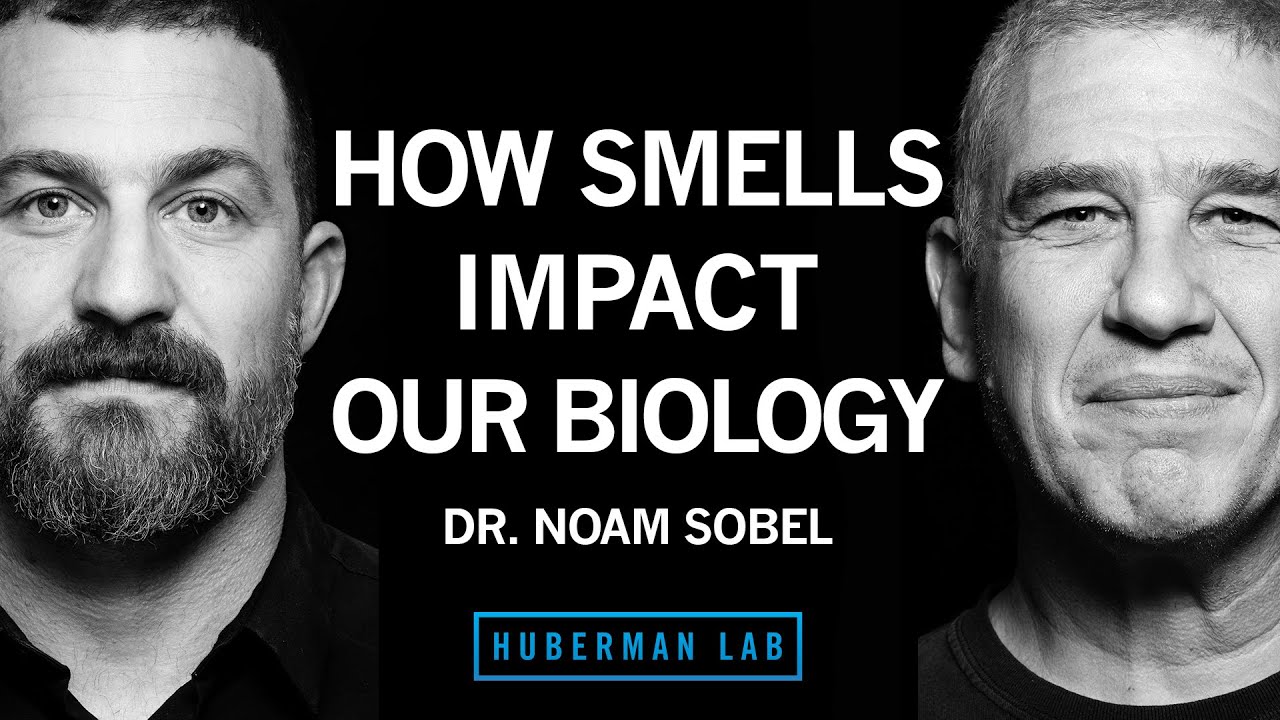
Noam Sobel — Professor of neurobiology at the Weizmann Institute of Science in Israel, formerly at UC Berkeley. His lab studies olfaction and chemosensation, with landmark work on human scent-tracking, the nasal cycle, and social chemosignaling.
The gist
Andrew Huberman interviews olfaction researcher Noam Sobel about how powerful and underrated the human sense of smell really is. They cover the architecture of the olfactory system, the surprising fact that humans can track scent trails nearly like dogs, and the nasal cycle that alternates airflow between nostrils as a marker of autonomic balance. Sobel details his lab's discoveries in social chemosignaling: handshakes as covert self-sampling, body-odor-based 'click' friendships, the smell of fear, a possible human Bruce-effect link to repeated pregnancy loss, and how baby-head hexadecanal modulates aggression differently in men and women. The conversation closes on emotional tears lowering testosterone and the race to digitize smell for transmission over the internet and future medical diagnostics.
Big reveals
- The famous 'a billion receptors in a bloodhound's nose' textbook claim was completely made up and propagated worldwide with zero evidence.
- A lab-picnic bet over whether humans could scent-track like dogs became a Nature Neuroscience paper proving they can, blindfolded.
- Sobel tested 14 yoga teachers who claimed they could switch nostril airflow by will alone; zero succeeded.
- His lab showed people covertly sniff their own hands after a handshake, captured on hidden video and published in eLife.
- An electronic nose could predict who would become friends, suggesting body-odor similarity helps cause 'click' friendships.
- Women experiencing unexplained repeated pregnancy loss identify their partner's body odor with more than double the accuracy of controls, hinting at a human Bruce-type effect.
- Hexadecanal from baby heads lowers aggression in men but raises it in women, a striking sex-dependent dissociation.
- Sniffing women's emotional tears (which are completely odorless) drops free testosterone in men by about 14% within 20-30 minutes.
- Sobel's lab transmitted the first odor over the internet (violets), recreated from molecular measurements via an algorithm.
Things worth remembering
- The olfactory nerve passes through the cribriform plate; whiplash to the back of the head can shear and permanently sever it.
- A study timed human olfactory bulb neurons using carbon-14 from atomic-bomb-era radiation exposure in postmortem tissue.
- Humans can detect mercaptans added to gas at 0.2 parts per billion, better than any gas chromatograph.
- Participants can smell a single drop of estratetraenol diluted across an Olympic-size swimming pool.
- The nasal cycle alternates the high-flow nostril roughly every two and a half hours and is linked to autonomic balance.
- Sobel's 'nasal holter' wearable can distinguish ADHD from non-ADHD adults and tell if they're on Ritalin from airflow alone.
- People perform significantly better on a visual-spatial task during nasal inhalation than during exhalation.
- Loss of smell can precede other Parkinson's symptoms by about 10 years but isn't specific enough to be diagnostic.
- Congenital anosmia (about 0.5% of people) is diagnosed at an average age of 14, often without earlier awareness.
- Olfactory pleasantness correlates about 0.8 across humans; we are far more similar in what smells good than people assume.
Recommended in this episode
Books, products and media the guest or host genuinely endorsed here — with the buy link.
Affiliate link — we may earn a commission at no extra cost to you.
Jaws: The Story of a Hidden Epidemic
Sandra Kahn and Paul R. Ehrlich (inferred)
“I'm a big fan of the book Jaws a hidden epidemic written by colleagues of mine at Stanford familiar with it” — Andrew Huberman 00:53:00Find it on Amazon