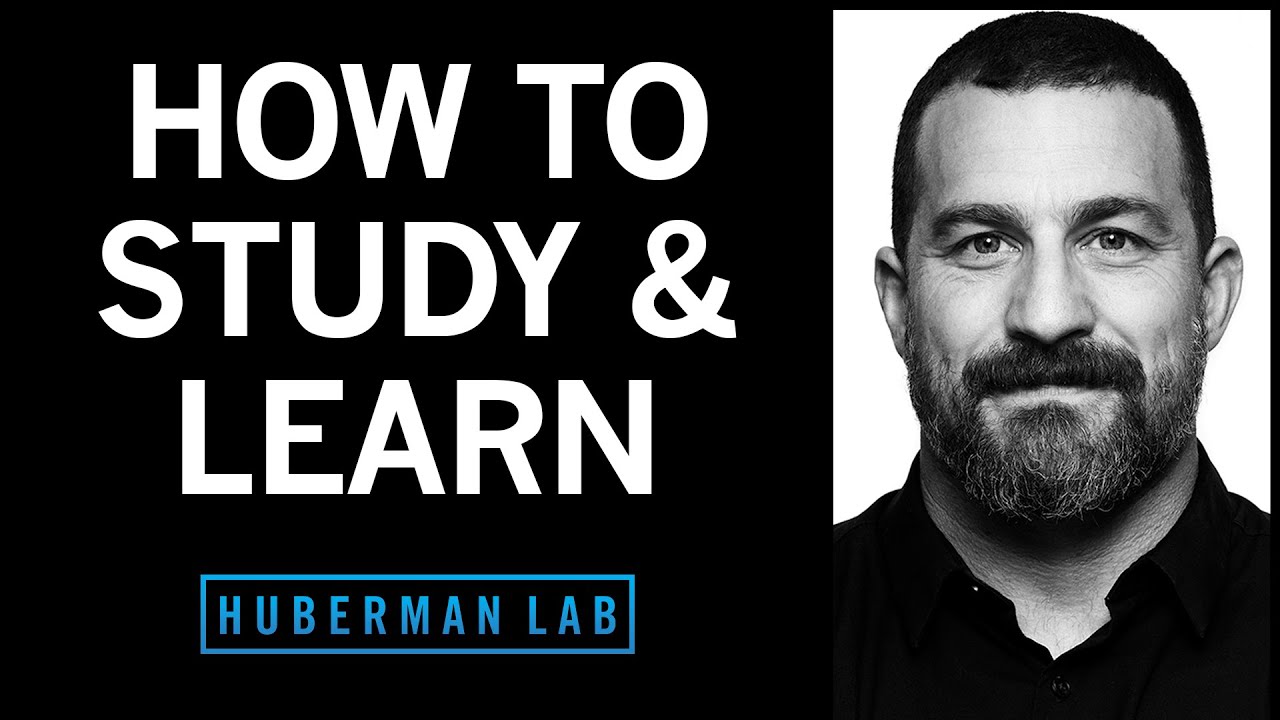
Andrew Huberman (solo episode) — Stanford professor of neurobiology and ophthalmology and host of the Huberman Lab podcast, translating peer-reviewed neuroscience into practical protocols.
The gist
In this solo episode, Andrew Huberman reframes effective studying as offsetting the brain's natural forgetting rather than simply 'learning.' He reviews the neuroscience of neuroplasticity (strengthening, weakening, and rare new neurons), the roles of focus, sleep, and NSDR, and the habits of highly effective students. The core argument, drawn from over a century of research, is that self-testing shortly after first exposure to material is far more effective than rereading, even when test scores are initially low. He closes with supporting tools: emotion, story, gap effects, and interleaving.
Big reveals
- Claims preferred 'learning styles' (visual, auditory, etc.) largely melt away under research scrutiny.
- Argues testing is not just for evaluation but is one of the best tools to build and retain knowledge.
- Reveals students who reread feel most confident but actually perform worst versus those who self-test.
- States testing very soon after first exposure beats spaced or late testing for long-term retention.
- Says a single self-test after learning can roughly halve forgetting, about a 50% improvement.
- Cites a medieval practice of throwing learners into cold water to deploy adrenaline and lock in memory.
- Recommends open-ended short-answer self-tests over multiple-choice, which only build familiarity.
Things worth remembering
- Adding new neurons (neurogenesis) is rare in adults and trivial for everyday learning; strengthening and weakening connections dominate.
- Improved motor coordination from infancy to adulthood largely reflects the removal of neural connections, not their addition.
- A 10-minute daily mindfulness meditation (Wendy Suzuki's NYU lab) improves focus, memory, and recall.
- The best-performing students study ~3-4 hours/day, broken into 2-3 sessions, alone, with phones away.
- A 1917 study found kids who self-tested on biographies after one read vastly outperformed those who reread.
- The habenula, a brain structure tied to disappointment and depression, is suppressed by morning sunlight.
- 'Gap effects': 5-30 second pauses let the hippocampus replay new material 20-30x faster, as during REM sleep.
- Teachers who joke or swear are rated more likable but receive lower overall teaching evaluations.
- Interleaving unrelated anecdotes into study material can enhance overall learning by linking it to existing knowledge.
Recommended in this episode
Books, products and media the guest or host genuinely endorsed here — with the buy link.
Affiliate link — we may earn a commission at no extra cost to you.
Protocols: An Operating Manual for the Human Body
Andrew Huberman
“I have a new book coming out. It's my very first book. It's entitled Protocols, an Operating Manual for the Human Body.” — Andrew Huberman 01:39:27Find it on Amazon