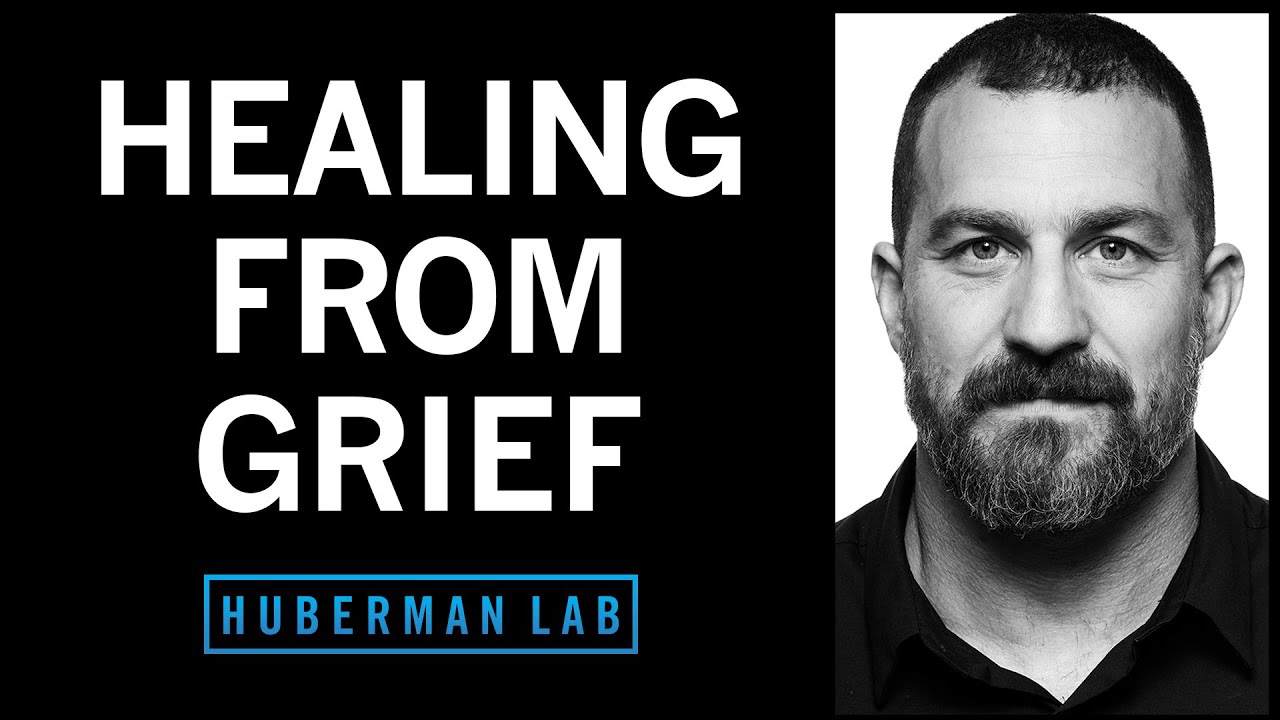
Andrew Huberman — Professor of neurobiology and ophthalmology at Stanford School of Medicine and host of the Huberman Lab Podcast. This is a solo episode with no outside guest.
The gist
Andrew Huberman delivers a solo deep dive on the neuroscience and psychology of grief, arguing it is not merely sadness but a motivational, dopamine-driven yearning state. He explains that we map relationships across three dimensions, space, time, and closeness, and that grief requires unbraiding attachment from the space and time predictions our brains keep generating. He covers the brain regions and cell types involved (nucleus accumbens, inferior parietal lobule, place, proximity, and trace cells), debunks the rigid Kubler-Ross stage model, and distinguishes complicated from non-complicated grief. He offers tools like dedicated rational-grieving sessions, building vagal tone through exhale-led breathing, and regulating cortisol via morning sunlight and sleep to move through grief adaptively.
Big reveals
- Grief rarely responds to antidepressants while depression often does, showing they are distinct brain processes.
- Huberman cites research showing complicated grief activates the nucleus accumbens reward center, proving grief is a craving state.
- Recent research refutes the idea that everyone moves linearly through Kubler-Ross's five stages of grief.
- Huberman reads Richard Feynman's letter to his dead wife Arline, ending 'I don't know your new address,' as a perfect illustration of grief's space-time-closeness map.
- Trace cells fire to signal the absence of someone who should be at a location, explaining why you expect the deceased to walk through the door.
- People with the highest pre-treatment adrenaline levels have the worst complicated-grief outcomes, so calming your baseline can inoculate you against it.
- A vagal tone study found emotional-disclosure writing only helped people with high respiratory sinus arrhythmia.
Things worth remembering
- Complicated grief, which fails to resolve over a prolonged period, occurs in about one in ten people.
- Dopamine is not about feeling good but about putting us into a state of desiring and seeking things.
- The inferior parietal lobule is uniquely activated by distance in space, time, and emotional closeness alike.
- Grief resembles a phantom limb; Huberman felt a touch on his neck for years after his graduate advisor died.
- Monogamous prairie voles have far more oxytocin receptors in the nucleus accumbens than non-monogamous ones.
- Exhales slow the heart rate and inhales speed it up, a relationship called respiratory sinus arrhythmia you can train.
- Complicated grievers show significantly higher 4pm and 9pm cortisol than non-complicated grievers.
- Viewing morning sunlight without sunglasses or windows regulates cortisol; doing it through glass is at least 50 times less effective.
- Huberman kept reflexively expecting calls from his deceased advisor whose number still showed on his phone.
Recommended in this episode
Books, products and media the guest or host genuinely endorsed here — with the buy link.
Affiliate link — we may earn a commission at no extra cost to you.
Surely You're Joking, Mr. Feynman
Richard Feynman
“If you haven't already read books such as "Surely You're Joking, Mr. Feynman," or "What Do You Care What Other People Think," I encourage you to do so.” — Andrew Huberman 00:38:14Find it on Amazon
What Do You Care What Other People Think?
Richard Feynman
“If you haven't already read books such as "Surely You're Joking, Mr. Feynman," or "What Do You Care What Other People Think," I encourage you to do so.” — Andrew Huberman 00:38:14Find it on Amazon