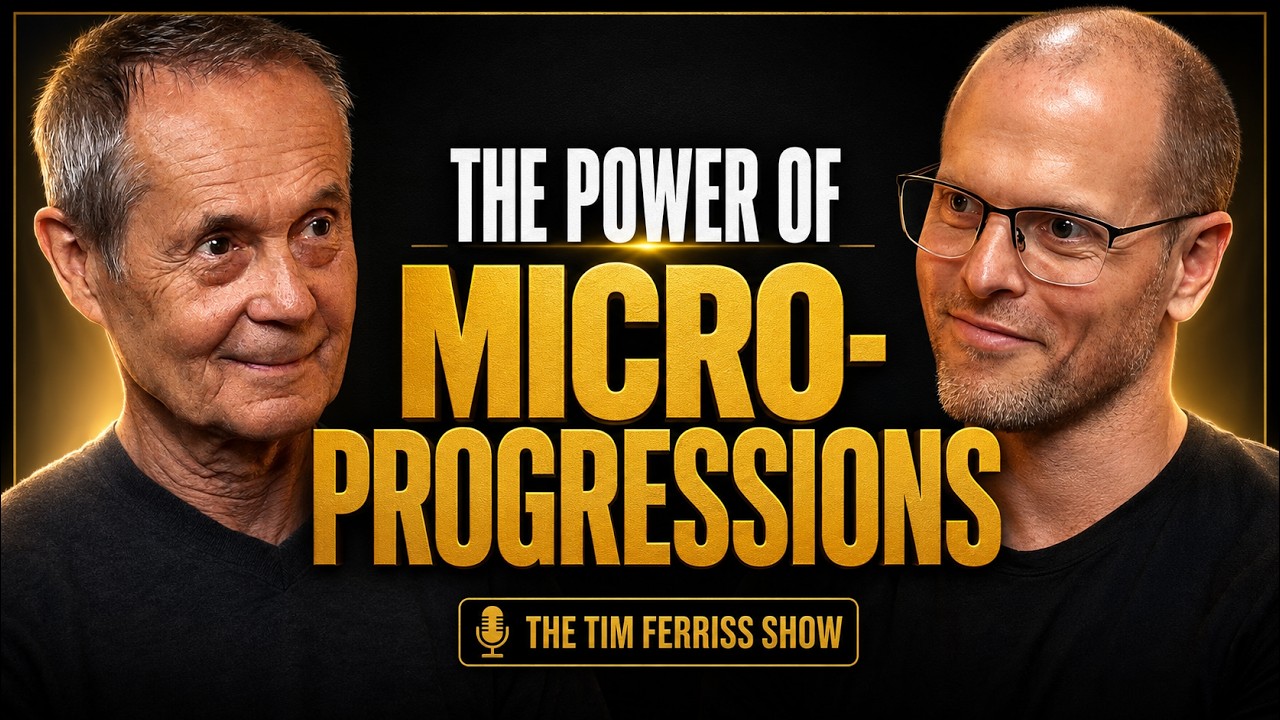
Jerzy Gregorek — Four-time world weightlifting champion, co-founder of UCLA's weightlifting team, co-creator with his wife Aniela of the Happy Body Program, and Olympic strength coach who coached Tajin Park, a young man with cerebral palsy and autism, through a five-year transformation.
The gist
Tim Ferriss interviews Olympic weightlifting coach Jerzy Gregorek about his five-year coaching of Tajin Park, a 25-year-old man with cerebral palsy and autism who was lethargic, nonverbal, fell daily, and couldn't use the restroom on his own. Jerzy applied an athlete's mindset of forward progress rather than the comfort-and-recovery approach used by physical therapists, treating strength, math, language, poetry, and philosophy as connected forms of brain development. Through micro-progressions, Tajin went from unable to unrack 15 pounds to bench-pressing 170, and from counting to ten to passing 57 college units on the way to San Jose State. The conversation explores the specific techniques used and Jerzy's belief that the method could be researched and replicated to help the roughly one million people with cerebral palsy in the US. Ferriss points listeners to the documentary 'Prisoner No More' and a web form for those wanting to support a formal research study.
Big reveals
- On day one Tajin couldn't unrack a 15-pound bar; Jerzy started him with a 3-pound wooden child's bar, and Tajin eventually bench-pressed 170 pounds at about 140 body weight, surpassing his own father.
- After almost five years of training, Tajin is in community college, has passed 57 units, is waiting on three more to finish 60 and transfer to San Jose State, and now writes essays in English.
- His father reported that after about a year of training they had their first real conversation, having previously only exchanged words about going to bed or eating.
- Because Tajin couldn't squat or turn, he couldn't use the restroom alone; once he could squat to 16 inches, Jerzy told the father he was ready to handle the restroom and dressing himself independently.
- Jerzy used the concept of becoming an 'adult' as motivation, telling Tajin he could quit piano and training once he jumped onto an 18-inch box, which lit a fierce drive in him.
- Once Tajin could bench-press about 100 pounds, he had enough resting energy to study at his computer for hours, completing elementary school in two years and high school in another two.
- Jerzy proposes a five-year research study starting with five cerebral palsy patients trained twice weekly, adding five each year up to about fifteen, to test whether the method is replicable.
Things worth remembering
- Tajin's negativity manifested as hating the sun, the police, his mother and father; Jerzy assigned him to write about why each was good to expand his acceptance and imagination.
- Tajin was 25 when training began, carrying decades of habits; his father drove him 1.5 hours each way twice a week, about four hours per trip, for five years.
- After six months Tajin began noticing cars; Jerzy had him memorize their color, make, and driver's gender, and Tajin started memorizing license plates, revealing his potential for math.
- For every broken record in squat or bench press, Jerzy gave Tajin a printed diploma at a family dinner celebration, helping him build a personal history and memory.
- Assigned a school essay on a hero, Tajin chose Genghis Khan; Jerzy reframed heroism as risking one's life to save others, citing a Korean admiral who faced 300 Japanese ships, and had Tajin rewrite the essay.
- Jerzy used poetry to teach emotion and metaphor, having Tajin recite and analyze poems line by line because at first he had no clue about the feelings words express.
- Jerzy coached an 18-year-old girl named Jewel in Hawaii who couldn't control her head, arms, or legs, finding her starting point by having her touch a ball held an inch from her hand.
- Jerzy proposes assessing patients from five perspectives: physical, math, language, philosophy, and beliefs.
- Roughly one million people have cerebral palsy in the US, with an estimated 100,000 to 120,000 in California alone.
- Tim Ferriss did the voiceover for the documentary 'Prisoner No More,' directed by Jeff Wolf, a roughly 30-minute film about Tajin's transformation.
Recommended in this episode
Books, products and media the guest or host genuinely endorsed here — with the buy link.
Affiliate link — we may earn a commission at no extra cost to you.
Prisoner No More
Jeff Wolf (inferred)
“the doc which I'm making available for free on YouTube, which is called Prisoner No More. We'll have more to say about that.” — Tim Ferriss 00:02:35Find it on Amazon
The Happy Body Program
Jerzy Gregorek and Aniela Gregorek
“co-creator with his wife, Aniela, the lovely Aniela, of the Happy Body Program. There's a lot more to his story.” — Tim Ferriss 00:01:33Find it on Amazon