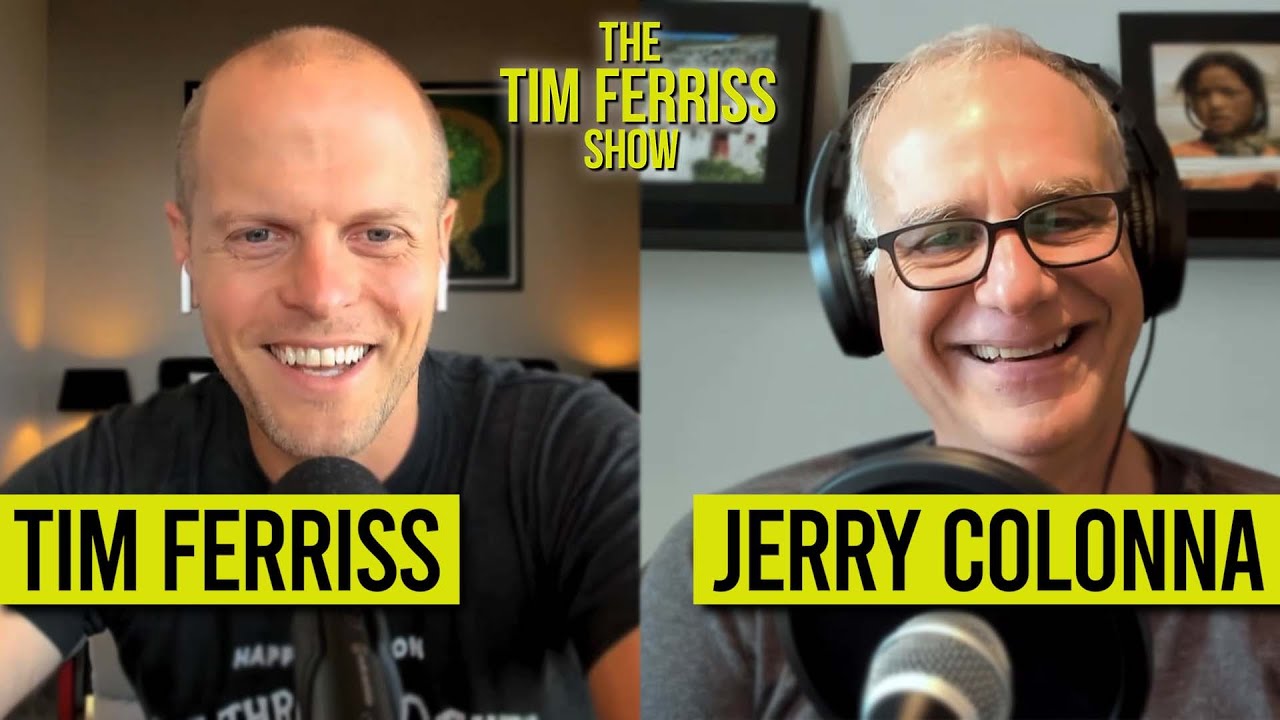
Jerry Colonna — CEO and co-founder of reboot.io, an executive coaching and leadership development firm. A former venture capitalist (Flatiron Partners, JPMorgan Partners) turned coach and author of the book Reboot.
The gist
Jerry Colonna returns to the Tim Ferriss Show to discuss his practice of taking two-month sabbaticals annually for roughly a decade. He and Tim get tactical about how to set up sabbaticals, manage email and expectations, and avoid turning rest into another source of self-criticism. The conversation moves from practical plumbing into deeper territory: why people resist rest, the difference between hot and cold boredom, and how busyness and complexity often serve to avoid uncomfortable feelings. Tim opens up about sitting with a year of void, his struggles with loneliness, and his past suicide attempt, while Jerry reframes rest as a holy, restorative sabbath. They close by reading John O'Donohue's blessing for the exhausted and David Wagoner's poem 'Lost.'
Big reveals
- Jerry reveals he had taken nine straight years of two-month sabbaticals, with this past one being his tenth, only interrupted once because of the disruption of 2020.
- Jerry discovered that taking sabbaticals made him a much better coach because he came back rested and could be more fully present for his clients.
- Jerry's key tactical lesson is to set expectations in advance; when founding reboot in 2014 he insisted the financial model must allow him to take two months off per year or he wouldn't do it.
- Jerry's reframing question: instead of 'How am I complicit in creating the conditions I say I don't want,' ask 'What benefit do I get from the conditions I say I don't want?'
- Jerry argues the core driver of busyness and complexity is not wanting to be alone with one's own thoughts and feelings, citing Tara Brach's question 'What are you unwilling to feel?'
- Tim discloses he spent roughly a year deliberately sitting with a 'void,' which became one of the most painful experiences of his life and ultimately felt unhealthy for his mental health.
- Tim shares that in college he had a date on the calendar to kill himself, partly from being too alone and isolated, distinguishing his fear of feeling lonely from actually being alone.
- Jerry reveals he attempted suicide at 18 and still makes his bed every day because that habit, learned in the mental hospital, keeps him from sliding back emotionally into that place.
Things worth remembering
- The word 'sabbatical' shares the same root as 'sabbath,' framing it as a holy time of rest and thinking differently rather than merely time off.
- Bill Gates popularized the term 'think week,' which Jerry frames as the same impulse: not not-working, but working on something other than what you're normally compelled to work on.
- Studies have shown that unlimited paid time off leads people to take less time off because there's no defined structure or norm around it.
- Jerry's sabbatical away message once joked that his plan was to eat more gelato than read email, so if you got an email from him, he had failed.
- Jerry notes that at the bottom of the Grand Canyon you are roughly four billion years into the past, calling it an extraordinary way to disconnect.
- Jerry handed in 15,000 words of a planned 70,000-word manuscript, but says he was most productive when he stopped trying to be productive.
- Jerry defines hot boredom as the achy discomfort of waiting in an interminable line, versus cold boredom, the calm, drama-free state reached deep into a meditation retreat that the mind actually needs.
- Brad Feld introduced Jerry to the concept of a 'digital sabbath,' turning off devices from Friday until Sunday night.
- Jerry references Irish poet John O'Donohue's book 'To Bless the Space Between Us,' which contains a blessing for the exhausted advising to 'steer clear of those vexed in spirit.'
- The episode closes with David Wagoner's poem 'Lost,' which Tim calls his north star: 'Stand still. The forest knows where you are. You must let it find you.'
Recommended in this episode
Books, products and media the guest or host genuinely endorsed here — with the buy link.
Affiliate link — we may earn a commission at no extra cost to you.
What About Bob?
“for more on this watch the movie what about bob which is which is a very good anybody who watches the movie will get the reference” — Jerry Colonna 00:05:12Find it on Amazon
Reboot: Leadership and the Art of Growing Up
Jerry Colonna
“he is the author of reboot subtitle leadership and the art of growing up as i mentioned this is his second appearance on the podcast” — Tim Ferriss 00:01:32Find it on Amazon
Vagabonding
Rolf Potts (inferred)
“a book called vagabonding by a now friend after i read the book and gave it to many many many many many many people i later became friends with the author ralph potts” — Tim Ferriss 00:09:54Find it on Amazon
To Bless the Space Between Us
John O'Donohue (inferred)
“john o'donoghue the great irish poet the late irish poet has a book of blessing called to bless the space between us and in it he has a blessing for those who are exhausted” — Jerry Colonna 01:11:20Find it on Amazon