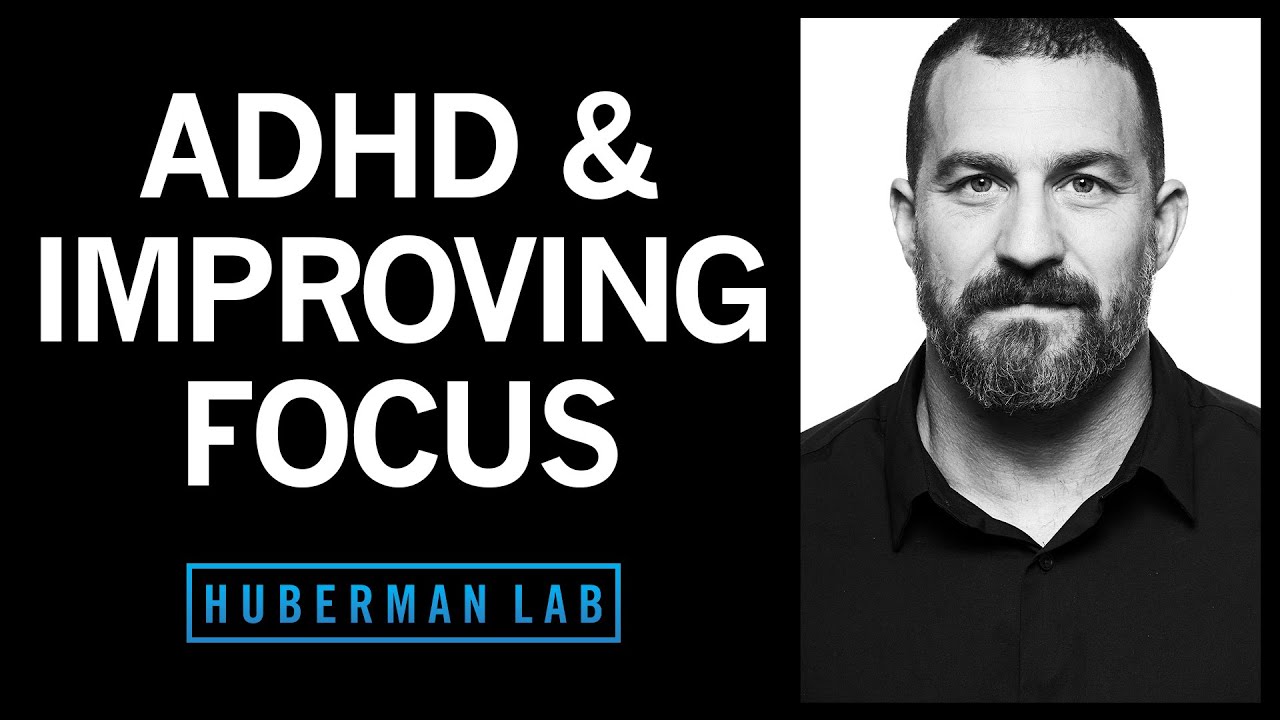
Andrew Huberman — Professor of neurobiology and ophthalmology at Stanford School of Medicine and host of the Huberman Lab podcast. This is a solo episode with no guest.
The gist
In this solo episode, Andrew Huberman breaks down what ADHD actually is, framing it around dopamine and the interplay between the brain's default mode network and task networks. He explains why stimulants like Ritalin and Adderall (chemically close to street amphetamines) can paradoxically calm and focus people with ADHD, and reviews the evidence on diet, omega-3s, and other supplements. He then offers behavioral and emerging tools, including a one-time 17-minute interoception practice, panoramic vision/open monitoring, blink and visual fixation training, fidget outlets, and transcranial magnetic stimulation. He closes by warning that heavy smartphone use is inducing ADHD-like attention problems in people of all ages.
Big reveals
- Contrary to stereotype, people with ADHD can achieve effortless hyper-focus on things they love, proving the capacity to attend exists.
- In people with ADHD the default mode and task networks are abnormally correlated rather than anti-correlated, with dopamine acting as the failing conductor.
- Up to 25% of college students and as many as 35% of people aged 17-30 take Adderall without an ADHD diagnosis, now exceeding cannabis use in that group.
- The ADHD prescription drugs are structurally and chemically nearly identical to street cocaine and amphetamine, separated by a 'fine and blurry line.'
- A single 17-minute meditation-like interoception session significantly and near-permanently reduced attentional blinks, improving focus.
- Blinking resets time perception and is controlled by dopamine, which is why low-dopamine ADHD individuals underestimate time and run late.
- Huberman admits the right dose of armodafinil for him is 'zero milligrams' after he once lectured for four and a half hours straight on it.
- Studies suggest adolescents must limit smartphone use to under 60 minutes a day to avoid significant attention deficits.
Things worth remembering
- ADHD (then ADD) appears in the medical literature as early as 1904 and has a strong genetic component, with up to 75% concordance in identical twins.
- ADHD has no relationship to intelligence or IQ of any kind.
- Sugar makes non-ADHD kids hyperactive but tends to calm ADHD kids because it raises dopamine.
- Nicotine, caffeine, cocaine, and amphetamine all raise dopamine, which is why people with ADHD historically self-medicated with them.
- In the 2011 Lancet elimination-diet study, every measured effect had a p-value below 0.0001, an extraordinarily strong result.
- For attention specifically, getting above 300 mg per day of DHA is the key inflection point, not just EPA.
- Chronic 10-year cannabis users blink far less than non-users, reflecting cannabinoid-dopamine interactions.
- Surgeons tap a foot or bounce a knee to shunt premotor activity so their hands stay steady, the same principle behind fidget toys.
- TMS spatial precision is 'not a cannon but not a needle,' yet can be used to stimulate prefrontal circuits paired with focused learning tasks.
- Huberman recommends examine.com for evidence on compounds like L-tyrosine and PEA and their relation to ADHD.
Recommended in this episode
Books, products and media the guest or host genuinely endorsed here — with the buy link.
Affiliate link — we may earn a commission at no extra cost to you.
Altered Traits: Science Reveals How Meditation Changes Your Mind, Brain, and Body
Daniel Goleman and Richard Davidson
“from an excellent book that I recommend, if any of you are interested in neuroscience and things like meditation... the book is called, "Altered Traits."” — Andrew Huberman 01:11:07Find it on Amazon
Deep Work
Cal Newport
“I'm a big fan of Cal Newport who wrote the book "Deep work." He's also written an excellent book, "A world without Email."” — Andrew Huberman 02:12:28Find it on Amazon
A World Without Email
Cal Newport
“He's also written an excellent book, "A world without Email." I've never met him, but I'm a huge admirer of his work” — Andrew Huberman 02:12:28Find it on Amazon