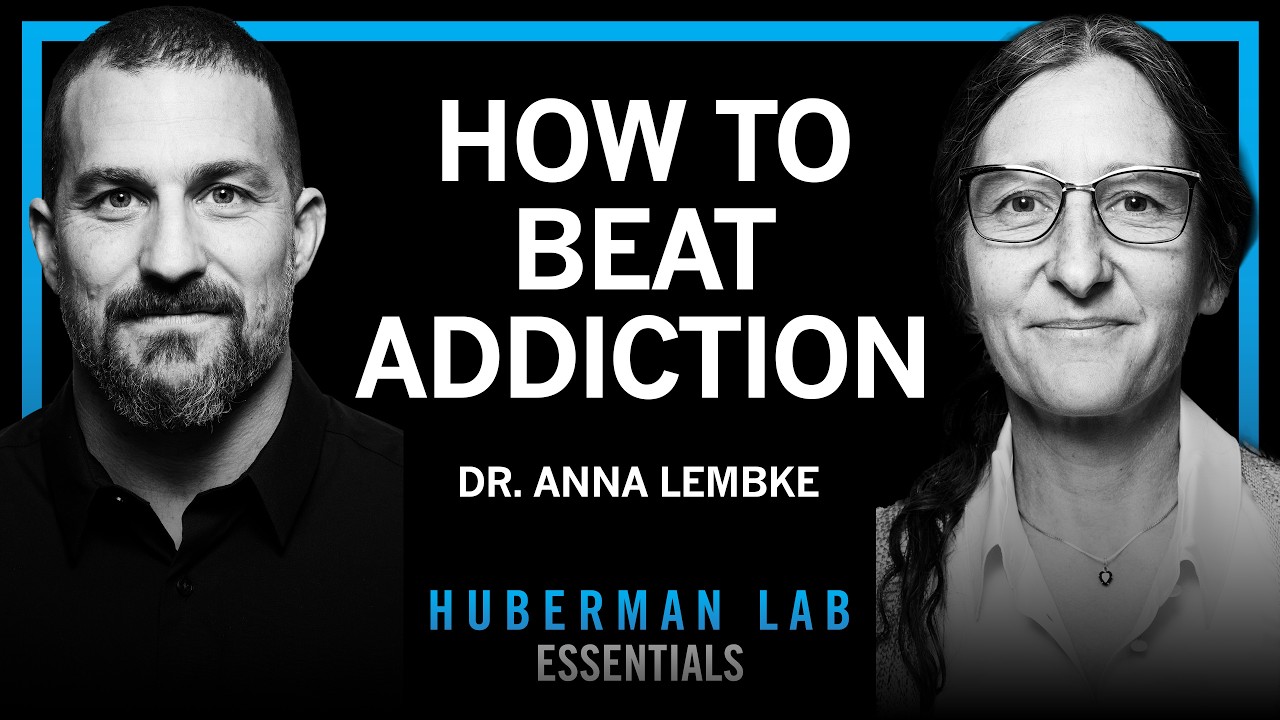
Dr. Anna Lembke — Psychiatrist and Chief of the Stanford Addiction Medicine Dual Diagnosis Clinic. Author of the bestselling book 'Dopamine Nation' and a leading expert on addiction and the neuroscience of reward.
The gist
This Huberman Lab Essentials episode revisits Andrew Huberman's conversation with addiction psychiatrist Dr. Anna Lembke about dopamine and addiction. Lembke explains that dopamine operates around a tonic baseline and that pleasure and pain are co-located in the brain, working like a balance that always seeks to return to neutral. She describes how repeated overindulgence in high-reward substances or behaviors tips the balance toward pain, producing a dopamine deficit state akin to depression. The discussion covers the roughly 30-day reset needed to restore reward pathways, why people relapse even when life is going well, the central role of truth-telling in recovery, and the cautious case for psychedelic-assisted therapy. It closes with a warning that social media is engineered like a drug and must be used with intention.
Big reveals
- Lembke says it is the deviation from a tonic dopamine baseline, not hits in a vacuum, that matters.
- Calls pleasure and pain being co-located in the brain one of the most significant neuroscience findings of the last 75 years.
- Explains the pain response overshoots, pushing pain higher than the original pleasure.
- States it takes about 30 days of abstinence to reset the brain's reward pathways.
- Reveals people often relapse when things are going well, as success removes the hypervigilance keeping use in check.
- Argues psychedelic-assisted therapy is a 'dopamine feast,' not a fast, and should violate dopamine biology.
- Declares social media really is a drug, deliberately engineered to be one.
Things worth remembering
- Dopamine is linked to both reward and movement, because early humans had to move to seek food and water.
- People who are depressed may have lower tonic baseline levels of dopamine.
- Impulsivity is a key risk factor for addiction, but may be a trait that was advantageous in other environments.
- Recovery typically feels worse for the first two weeks, with the 'sun coming out' in week three.
- Even just thinking about a trigger releases a mini dopamine spike followed by a mini deficit, which is craving.
- Truth-telling may strengthen prefrontal cortex connections to the limbic and reward brain.
- Honest, intimate connections with others themselves create dopamine.
- Casual self-directed microdosing for a 'spiritual awakening' almost never works out well.
- Constant phone-checking may be eroding our ability to sustain a single thought, the source of creativity.
- Dr. Lembke is not on social media, staying true to her own ideology.
Recommended in this episode
Books, products and media the guest or host genuinely endorsed here — with the buy link.
Affiliate link — we may earn a commission at no extra cost to you.
Dopamine Nation: Finding Balance in the Age of Indulgence
Dr. Anna Lembke
“And there, I talk about some studies in my book that kind of indirectly show that. So, I find that really fascinating.” — Dr. Anna Lembke 00:23:06Find it on Amazon