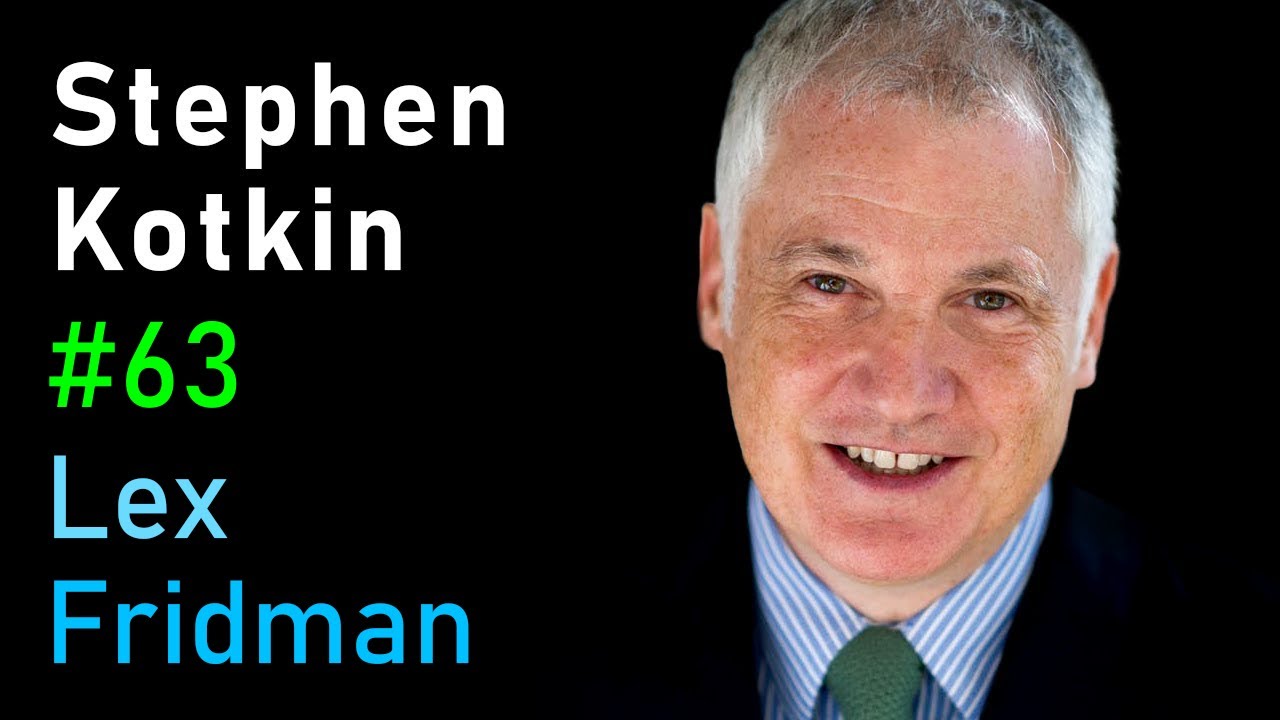
Stephen Kotkin — Professor of history at Princeton University and one of the leading historians of Russia and the Soviet Union. He is the author of a planned three-volume biography of Joseph Stalin, with the third volume in progress.
The gist
Lex Fridman talks with historian Stephen Kotkin about why some humans crave unconstrained power and why institutional constraints on executive authority are essential to long-term stability. Kotkin contrasts the American system of checks and balances with Russia's history of authoritarian rule, analyzing Vladimir Putin's appeal, the corruption inside his regime, and Russia's hemorrhaging of human capital. He recounts Stalin's improbable contingent rise to power after the 1917 coup on the left and the stroke that sidelined Lenin. The conversation broadens into the difference between Marxist communism, social democracy, and capitalism, and closes on the enduring danger of great-power war.
Big reveals
- Kotkin argues the people who crave truly unconstrained life-and-death power are rare 'extraordinary people,' not the everyday people you encounter.
- Putin is 'the only dad the Russian people have' — the absence of real alternatives, not just merit, sustains his popularity.
- Putin is actually unpopular inside the state administration, where officials see the decline and the clique 'stealing everything in sight.'
- Russia grew at ~7% a year for a decade under Putin, and Kotkin insists oil prices (averaging ~$50/barrel) cannot explain it.
- Stalin's rise hinged on contingency: weeks after Lenin created the General Secretary post for him, Lenin had a stroke.
- Stalin was a genuine 'true believer' in communism and Russian statism, not merely a power-hungry cynic.
- Kotkin describes power as 'a drug' and 'an aphrodisiac' that leaders conflate with the well-being of the nation.
Things worth remembering
- America's system was deliberately designed to prevent government action quickly; the 'do-nothing' frustration is actually its institutional strength.
- The only checks on the despotic power Kotkin studies were circumstantial — like the 5,000-mile distances of the country and the 24 hours in a day.
- Somewhere between five and ten million people have left Russia since 1991, disproportionately the educated and entrepreneurial.
- China's phenomenal growth created insatiable demand that brought dead Soviet-era industry (steel, cement, fertilizer) back to life.
- The October Revolution was a coup 'on the left' against other socialists, not against the already-failed provisional government.
- Kotkin's metaphor: Marxism is like dropping a nuclear bomb while promising to minimize civilian casualties — the freedom never arrives.
- Kotkin notes his own mother could only get a credit card in her own name in the 1970s without his father co-signing.
- At least 55 million people died in World War II; a U.S.-China world war could mean hundreds of millions.
- Stalin's closing quote: 'who votes' doesn't matter, 'who will count the votes and how' is what is extraordinarily important.
Recommended in this episode
Books, products and media the guest or host genuinely endorsed here — with the buy link.
Affiliate link — we may earn a commission at no extra cost to you.
Stalin (three-volume biography)
Stephen Kotkin
“he has written many books on Stalin in the Soviet Union including the first to of a three-volume work on Stalin and he's currently working on volume three” — Lex Fridman 00:00:00Find it on Amazon