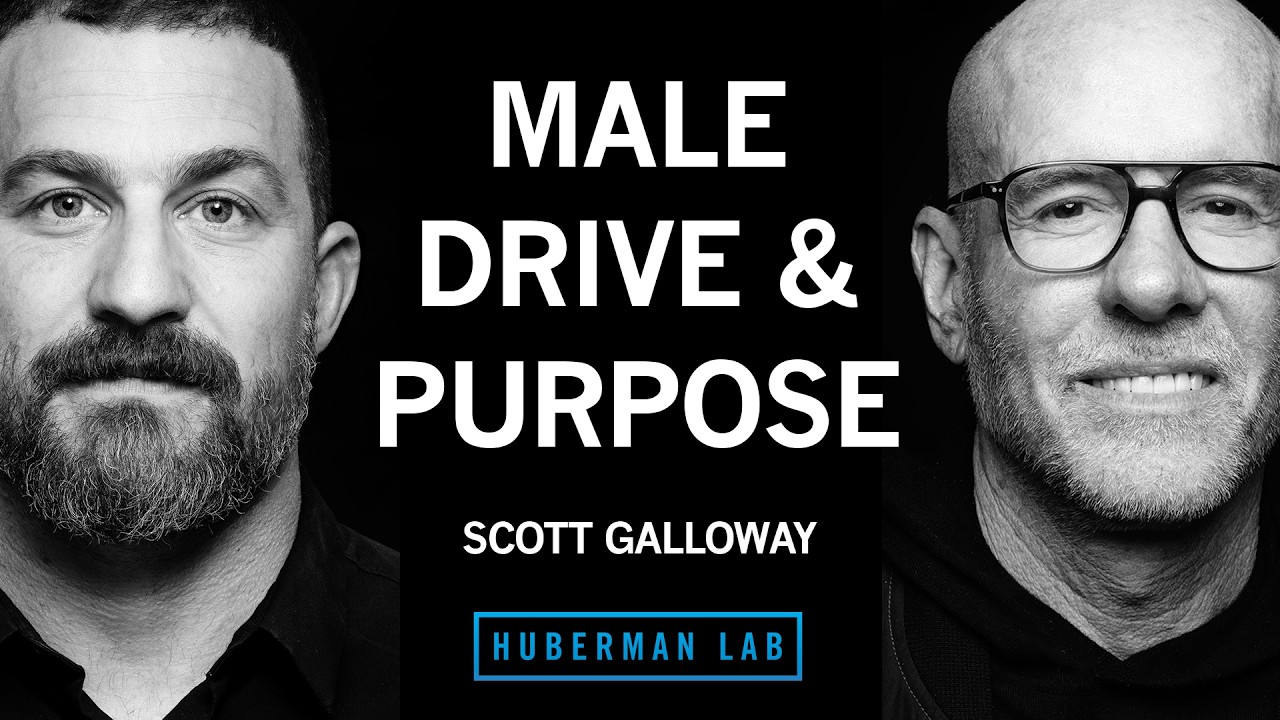
Scott Galloway — NYU Stern School of Business professor, author, and public educator on business, finance, relationships, and the modern male crisis. Hosts several popular podcasts and is known for blunt, data-grounded commentary.
The gist
Huberman and Galloway dig into what it means to be a fulfilled man in 2026, framed around Galloway's 'provider, protector, procreator' code plus service and creating 'surplus value.' Galloway lays out concrete daily tactics for struggling young men: work out three times a week, earn money outside the house, volunteer, and practice making approaches that risk rejection. They debate big tech's role in isolating and addicting young people, the politics of regulation, and whether figures like Elon Musk are net-positive role models. The conversation ranges across alcohol and cannabis as social lubricants, the under-researched harms of porn, testosterone, the wealth transfer from young to old via Social Security and tax policy, the failures of higher education, and a closing plea for older men to mentor boys who've lost male role models.
Big reveals
- Galloway names the U.S. president and 'the wealthiest man in the world' (Elon Musk) as role models who skipped the 'protector' part of masculinity.
- Galloway's mentoring 'hack': he has young men unlock their phones, admits his own porn use and options gambling to disarm them, then reclaims eight hours of wasted screen time.
- Galloway argues Musk's reported ketamine addiction, sleeping with a loaded gun, and not living with his kids are 'fair game' given how much he courts public affirmation.
- Galloway confesses deep impostor syndrome, fear it will 'all come crashing down,' and that he sometimes portrays himself as better than he is.
- Huberman reframes phone use as closer to clinical OCD than dopamine addiction, since the compulsion reinforces rather than relieves the obsession.
- Galloway's contrarian take: young people should drink more and go out, because the risks of loneliness outweigh the risks of moderate alcohol.
- Galloway reveals he uses 5mg THC edibles about twice a week for sleep and once scored marijuana on a Vegas street corner for his mother's cancer nausea.
- Galloway shares that he and his mother were the secret 'second family' of his childhood stock-market mentor, who he later learned had another family.
Things worth remembering
- A man under 30 who works out 3x/week, works 30 hours outside the home, and volunteers is already in the top 8% of young men.
- Only one in three men under 30 is in a relationship, versus two in three women, because women date older.
- About 2,500 women a year are murdered by men but 40,000 men kill themselves; a man on a date is far likelier to harm himself than his date.
- A New Mexico AG posed as a 12-year-old girl online and within minutes received solicitations from known sexual predators.
- There are more full-time lobbyists in D.C. working for Amazon alone than there are sitting U.S. senators.
- The lowest youth-depression rates in the West are in Israel and Singapore, both of which have mandatory national service.
- Of 83 Carnegie Hero awards last year (running into danger to save others), 75 went to men.
- Social Security taxes top out at ~$160K of income, so a worker earning $150K pays the same dollar amount as someone earning millions.
- Galloway calls money the number-one predictor of longevity: China's life expectancy rose from 47 to 77 in 60 years as wealth grew.
- You're 77 times more likely to get into an elite university if you're from a top-1% household.