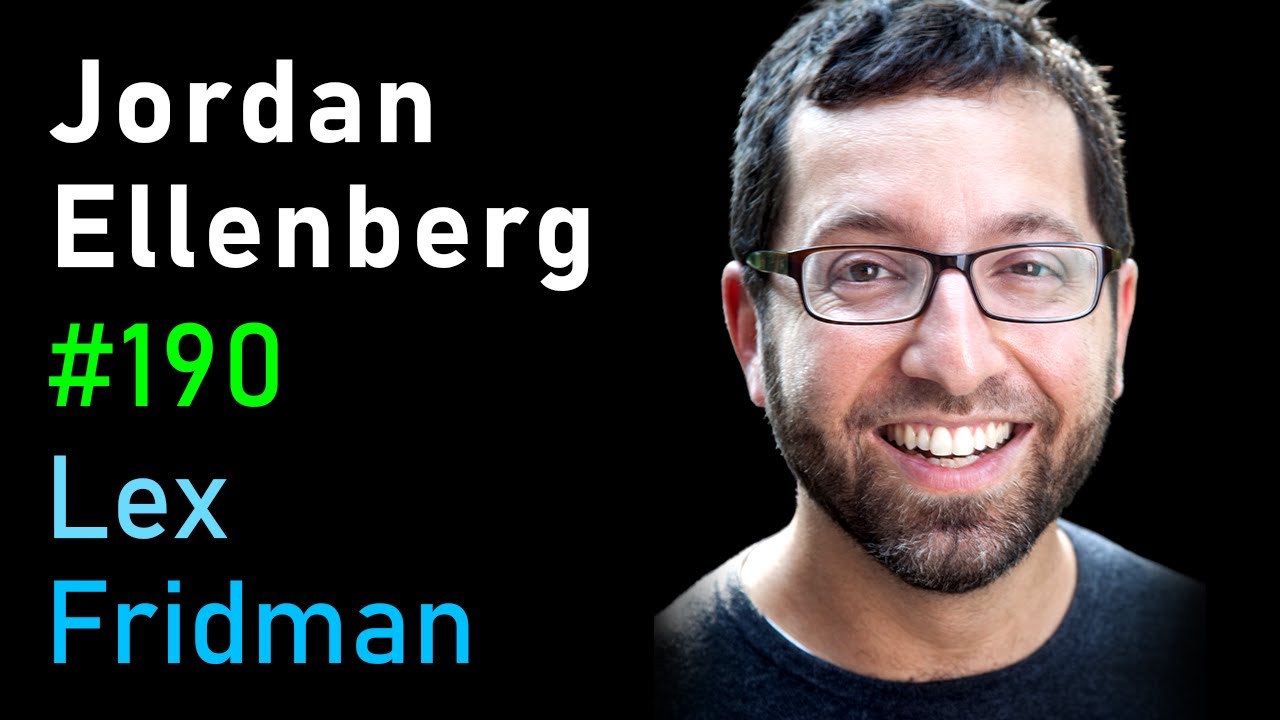
Jordan Ellenberg — A mathematician at the University of Wisconsin and an algebraic geometer. He is the bestselling author of 'How Not to Be Wrong' and 'Shape,' known for making the beauty and power of mathematics accessible to general readers.
The gist
Jordan Ellenberg and Lex Fridman explore geometry as a way of seeing hidden structure beneath the messy surface of the world. They range across symmetry and group theory, Poincare's invention of topology and higher-dimensional 'phase space,' and playful puzzles like how many holes a straw or a pair of pants has. The conversation digs into prime numbers, twin primes, Fermat's Last Theorem and Andrew Wiles's proof, the surprising power of treating deterministic things as random, and non-standard notions of distance. They also discuss Conway's Game of Life, cellular automata, AI and machine learning, the meaning of awards like the Fields Medal, and how anyone can learn math by letting a problem they actually care about drive their study.
Big reveals
- Ellenberg argues no known classical symmetry type can explain how humans distinguish a handwritten 2 from a 3, calling the brain's pattern recognition more complex than current math captures.
- Using Lex's coffee mug as a prop, Ellenberg explains the Poincare conjecture and 'simply connected' spaces through whether a loop of string can be pulled shut.
- He tells the story of the Conway knot being proven not-slice by Lisa Piccirillo in a paper just nine pages long, two of them pictures, raising the question of what 'difficulty' even means in math.
- Contrarian claim: believing the twin prime conjecture is not about deep structure but the opposite, treating primes as if they were random dirt strewn around.
- Ellenberg states flatly that Fermat almost certainly did NOT have a secret proof of his Last Theorem, deflating the romantic legend.
- On Perelman turning down the Fields Medal, the talk turns to integrity and standing on principle even when the world wants you to accept the prize.
- His core life advice: when facing a decision, make the 'high self-esteem choice', act as the version of you without self-doubt would act.
- He rejects the famous 'if you can't explain it simply you don't understand it' idea, saying real things are not simple and a poem is not an explanation.
Things worth remembering
- Ellenberg calls geometry 'the cilantro of math', people are never neutral about it; some love it, some are lost the whole year.
- His love of math began as a child staring at a 6-by-8 array of holes in a stereo speaker box and realizing 6 eights equals 8 sixes.
- After losing the Franco-Prussian war, France pushed hard to get strong in math like the Germans, a 19th-century 'Sputnik moment.'
- The romantic image of mathematicians like Galois (who died in a duel in his early 20s) was shaped by the Romantic movement's view of poetry and music.
- Ellenberg's daughter argued a pair of pants has only two holes because the waist is 'just the two leg holes stuck together', illustrating homology.
- Kumar's attempt to understand a flawed Fermat proof revealed that in more general number systems, unique prime factorization breaks down.
- The 'Grothendieck prime' 57 is a famous joke, the great mathematician picked it as an example prime, but it's actually 3 times 19.
- In '2-adic' number theory, two numbers are 'close' if their difference is a multiple of a large power of two, like binary numbers written backwards.
- Conway invented the Game of Life in the 1970s using just pen and graph paper, and reportedly felt ambivalent about being known mainly for it.
- At the 1987 International Math Olympiad in Havana, the U.S. team was taken on a field trip to the Museum of American Imperialism.
Recommended in this episode
Books, products and media the guest or host genuinely endorsed here — with the buy link.
Affiliate link — we may earn a commission at no extra cost to you.
How Not to Be Wrong
Jordan Ellenberg
“an author who masterfully reveals the beauty and power of mathematics in his 2014 book how not to be wrong” — Lex Fridman 00:00:00Find it on Amazon
Shape: The Hidden Geometry of Information, Biology, Strategy, Democracy, and Everything Else
Jordan Ellenberg
“in his new book just released recently called shape the hidden geometry of information biology strategy democracy and everything else” — Lex Fridman 00:00:00Find it on Amazon
Duel at Dawn
Amir Alexander
“i think you would love a book called duel at dawn by amir alexander which i think some of the things you're responding to” — guest 00:22:50Find it on Amazon
Mathematical recreations columns (collected books)
Martin Gardner
“i always recommend like the books of martin gardner he wrote a column in scientific american for decades called mathematical recreations” — guest 02:28:52Find it on Amazon
Golly
Golly developers (inferred)
“there's actually a great ipad app called golly which i really like that has like conway's original rule and like hundreds of other variants” — guest 02:02:05Find it on Amazon