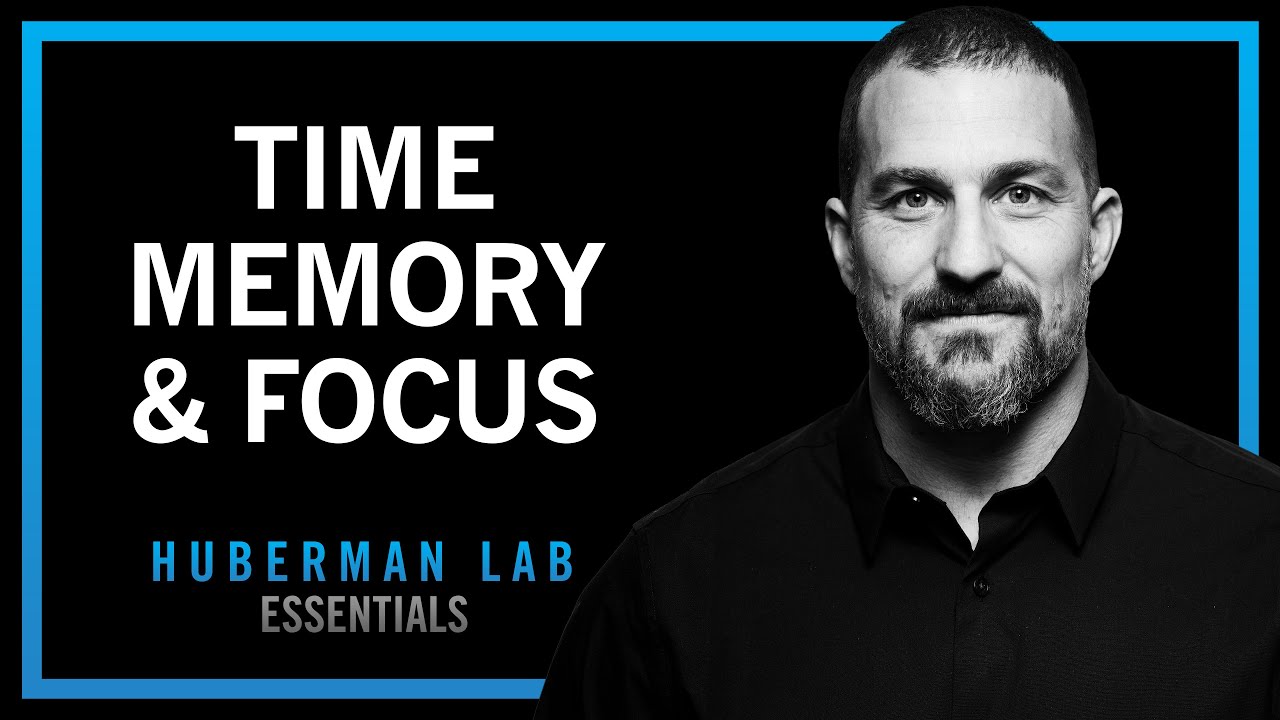
Andrew Huberman (solo) — Stanford professor of neurobiology and ophthalmology and host of the Huberman Lab podcast. This is a solo Huberman Lab Essentials episode revisiting his science of time perception.
The gist
Andrew Huberman explains how our perception of time governs mood, stress and how we judge our lives. He walks through the nested biological rhythms we are entrained to: yearly circannual cycles driven by light and melatonin, the 24-hour circadian clock, and 90-minute ultradian focus cycles. He then details how neuromodulators set our moment-to-moment 'frame rate' on time: dopamine and norepinephrine make us overestimate elapsed time and fine-slice experience, while serotonin makes us underestimate it. He connects this to memory and trauma 'overclocking,' to why fun days feel fast now but long in memory, and closes with practical tools like morning sunlight, timed exercise, 90-minute work blocks and dopamine-anchored daily habits.
Big reveals
- Core protocol: get 10-30 minutes of bright light (ideally sunlight) within an hour of waking, again in the afternoon, and minimize bright light at night.
- Claims hard focused work should be limited to ~90-minute ultradian blocks because acetylcholine and dopamine drop off after that.
- States that more dopamine makes us overestimate elapsed time, while serotonin makes us underestimate it.
- Explains 'overclocking' in trauma: dopamine and norepinephrine spike so high the event is stamped into memory in hyper-detail and is hard to shake.
- Reveals the paradox that fun, varied days feel fast in the moment but are remembered as long afterward.
- Argues dopamine-anchored habits at set times literally carve your day into time bins, not just make you feel good.
- Recommends Dean Buonomano's book 'Your Brain Is a Time Machine' for going deeper.
Things worth remembering
- Light seen by the eyes reduces melatonin, which controls sleepiness and helps regulate testosterone and estrogen.
- The brain averages light exposure across days so precisely it tracks seasonal day-length changes, partly explaining higher spring energy and lower winter mood.
- The master circadian clock sits in cells over the roof of your mouth and oscillates once every 24 hours.
- Circadian disruption raises cancer, obesity and mental-health risk and slows wound healing.
- In Aschoff's 1985 isolation studies, people in clock-free environments badly underestimated how long they'd been inside (guessing 8 days after ~42).
- You can start a 90-minute focus cycle whenever you choose, but performance inevitably drops by the 100-120 minute mark.
- Memory uses both a 'space code' (which neurons fire) and a 'rate code' (how fast), letting the hippocampus store far more memories.
- Dopamine is a molecule of motivation and drive, not simply reward, and is co-released with norepinephrine during high arousal.
- More novel experiences in a place or with a person make you feel you've been there, or known them, far longer.
Recommended in this episode
Books, products and media the guest or host genuinely endorsed here — with the buy link.
Affiliate link — we may earn a commission at no extra cost to you.
Your Brain Is a Time Machine: The Neuroscience and Physics of Time
Dean Buonomano
“I'd like to point you to a really excellent book called Your Brain is a Time Machine, the neuroscience and physics of time.” — Andrew Huberman 00:30:00Find it on Amazon